
Franz Liszt - Bagatelle sans tonalité, S. 216a
Dr. Michael Kaykov (Piano)
The Italians, 2021
This Week in Classical Music: October 17, 2021. The Italians. Three Italian composers were born this week: the Renaissance-era Luca Marenzio, who was born on October 18th of 1553, 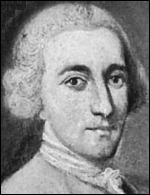 Baldassare Galuppi, born on the same day but a century and a half later, on October 18th of 1706, and Luciano Berio, one of the most interesting composers of the second half of the 20th century, on October 24th of 1925. Take a look at the entry about Marenzio here, Galuppi – here, and one of our takes on Berio here. It is said that Galuppi was the most successful and richest composer of the mid-18th century. His fame and money came mostly from his operas – he wrote more than 100 of them (we think that his sacred music is of much higher quality). He was called the father of comic operas (he wasn’t the first one to write opera buffa, but his were more popular), but practically none of them are staged these days. The comic opera Il filosofo di campagna, based on the libretto by Carlo Goldoni, was extremely popular throughout Europe. Here’s the cheerful overture. Francesco Piva leads the Italian group Intermusicale Ensemble.
Franz Liszt was also born this week, on October 22nd of 1811. Staying with the Italian theme, here is Sonetto 47 del Petrarca, from Années de pèlerinage: Italie. Lazar Berman recorded it in 1977.
Finally, the great Jewish-Hungarian-American conductor, Georg Solti was born (as György Stern) on October 21st of 1912. His first significant position was that of the music director at the Bavarian State Opera; he was then hired at the Frankfurt Opera and, in 1961, became the music director of the Covent Garden Opera. Only later did he develop his career as a symphony conductor. Solti recorded 45 complete operas, and even though his Wagner recordings are most famous (his recording of Der Ring des Nibelungen was voted the greatest recording ever made, twice: once by the Gramophone magazine in 1999, and the second time by professional music critics in a poll conducted by the BBC, in 2011) some of his Italian operas are also extremely good. Here is Io vengo a domandar grazia mia Regina, from Act II of Don Carlo. Carlo Bergonzi is Don Carlo, Renata Tebaldi – Elizabeth. Sir Georg Solti conducts the Orchestra of the Royal Opera House, Covent Garden.
Read more...Giuseppe Verdi - Io vengo a domandar grazia mia Regina, from Don Carlo
Carlo Bergonzi (Tenor)
Renata Tebaldi (Soprano)
Covent Garden Orchestra (Orchestra)
Georg Solti (Conductor)
Baldassare Galuppi - Il filosofo di campagna, Overture
Intermusicale Ensemble (Ensemble)
Francesco Piva (Conductor)
Robert Schumann - Intermezzo
Nico De Napoli (Piano)
Evgeny Kissin at 50
This Week in Classical Music: October 11, 2021. Evgeny Kissin. Evgeny Kissin, one of the greatest pianists of his generation, turned 50 yesterday. Kissin has been dazzling the public for 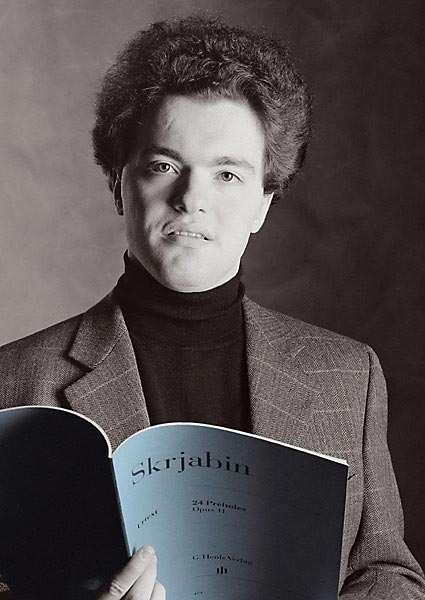 almost 38 years, since the time when, at the age of 12, he gave a performance at the Great Hall of the Moscow Conservatory (performing at the Great Hall is the Russian equivalent of performing at the Stern Auditorium of the Carnegie Hall: an honor and acknowledgement of the performer’s talent). Kissin was born in Moscow on October 10th of 1971. At the age of six he went to the Gnessin music school, where his teacher was Anna Cantor. Cantor, who died on July 27th of this year, remained his only teacher. Kissin and Cantor were uniquely close; she traveled with him and lived her last years in his home in Prague. Recognized as a child prodigy in the Soviet Union, Kissin started his international career at the age of 14. In 1987 he first played in what was then West Berlin; a year later, to great acclaim, he played Tchaikovsky’s First piano concerto under the direction of Herbert von Karajan. In 1990 Kissin played his debut American concert in New York, performing both of Chopin’s piano concertos with the New York Philharmonic and Zubin Mehta. A week later he gave a recital at the Carnegie Hall. In 1997 he made history by playing the first ever piano recital at the Proms in the Royal Albert Hall. Kissin has played with all major orchestras, all major conductors; he also played chamber music with many leading musicians of the day. His concerts are always sold out.
Kissin’s playing combines phenomenal technique with interpretive depth. There is no affectation in his performances. His repertoire is broad, but he’s best know for his Romantics, from Chopin, Schubert and Schumann to Rachmaninov. Kissin also writes poetry and prose and does so in Russian and, surprisingly,, in Yiddish. After leaving Russia, Kissin, who has Russian, British and Israeli citizenships, has lived in New York, London, and Paris. He nowlives in Prague with his wife and three children from her previous marriage.
Kissin has a broad discography and is well represented on all streaming services. Here’s something of a rarity, Schubert’s Piano Sonata no. 17 in D major D. 850. This live recording was made in Verbier in 2014.
Read more...Franz Schubert - Piano Sonata no. 17 in D major D. 850
Evgeny Kissin (Piano)
Johann Joseph Fux
This Week in Classical Music: October 4, 2021. Johann Joseph Fux. The great German composer of the early baroque, Heinrich Schütz was born this week in Köstritz, a town in 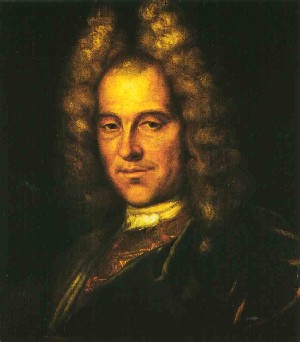 Thuringia, on October 8th of 1585 (we’ve written about him here and here). Also, Giuseppe Verdi was born on October 9th of 1813 and Camille Saint-Saëns, on the same day in 1835. Both are very popular (Verdi being a much bigger talent), and we’ve featured them many times. One composer who somehow escaped our attention is another German, Johann Joseph Fux. While Schütz was enormously influential as composer, Fux is more famous for his theoretical opus Gradus ad Parnassum (Steps to Mount Parnassus). It shouldn’t be confused with Carl Czerny’s Gradus ad Parnassum, a collection of study piano pieces familiar to most pianists. Fux’s Gradus is completely a different thing, and we’ll get to it in a minute.
Fux was bon in 1660 (the exact date isn’t known) in a village outside of Graz, in Austrian Styria. He probably studied music in Graz, and later served as organist in Ingolstadt, Bavaria. It seems that around that time he visited Italy and was influenced by Arcangelo Corelli and Bernardo Pasquini. Fux moved to Vienna in 1690 and several years later was hired as the court composer to the Emperor Leopold I. Leopold was a music lover, a patron and composer himself: some of his music survives, for example, an ordinary mass titled Missa angeli custodis and the Requiem Mass for his first wife (here on YouTube). Love for music ran in Leopold’s Habsburg family: his father, Ferdinand III, Holy Roman Emperor, was also a music benefactor and composer; 100 years later, Joseph II would become Mozart’s patron. Leopold thought highly of Fux and in 1715 made him the Hofkapellmeister, the leader of Wiener Hofmusikkapelle, an ancient musical institution established in 1498; abolished in 1922, it was the predecessor of the Vienna Boys’ Choir. At the Hofmusikkapelle Fux was assisted by Antonio Caldara, a well-known Italian opera composer. When Leopold I died in 1705, his son Joseph became the Holy Roman Emperor Joseph I, and, upon Joseph’s death, the title went to Leopold’s other son, Charles, who ruled as Charles VI. Both continued to employ Fux, who lived in Vienna the rest of his life, dying in 1741. As the court composer, Fux was required to write masses and other church music; he also composed operas, oratorios and Tafelmusik (Table music), music for feasts and banquets. Here is Fux’s Overture in D major, No. 4, performed by the Freiburger Barockorchester.
Back to Gradus ad Parnassum: Fux wrote it in 1725, in Latin, but soon after it was translated into German, French and English. The first part of the book talks about intervals and their relations to number. But it’s the second half that made it famous: it presents the theoretical discussion of counterpoint, instructions on how to write sacred music and other musical techniques. It’s written in the form of a dialogue, with one person, the teacher, representing Palestrina, and another, the student, Fux himself. A copy of Gradus ad Parnassum was in Johan Sebastian Bach’s personal library. Haydn used it to teach himself counterpoint and later recommended it to his student, Beethoven. Mozart had an annotated copy. The book was used continuously from the day it was published and is still used and cited today.
Read more...Johann Joseph Fux - Overture in D major, No. 4
Freiburger Barockorchester (Orchestra)
Franz Liszt - La Lugubre Gondola II, S. 200
Dr. Michael Kaykov (Piano)