
Morton Feldman - Madame Press Died Last Week At Ninety
Orchestra Of St. Luke's (Orchestra)
John Adams (Conductor)
Welcome to 2022
This Week in Classical Music: January 3, 2022. Welcome to 2022. We hope, as we assume do all our listeners, that 2022 turns out to be better, music-wise, than 2021. Even though the year hasn’t started outnvery promising, with the omicron variant spreading at an unusual rate, we think 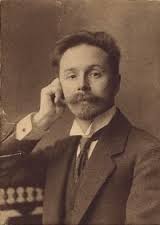 this might be the last gasp of the pandemic, finally creating the elusive heard immunity. We need all music venues to open, we need people come to the regular, not abridged concerts, we need to get rid of masks in concert halls, to able to travel, to provide education, musical and otherwise, in person – in other words, we need normalcy. If 2022 gets us there, it will be a great year.
Now, to the first week of 2022. We have one important anniversary: Alexander Scriabin was born on January 6th of 1872, 150 years ago. And then we have a very special pianistic date, January 5th, the birthday of not one but three exceptional pianists, Arturo Benedetti Michelangeli in 1920, Alfred Brendel in 1931, and Maurizio Pollini in 1942. Pollini and Brendel had a very broad repertoire, Michelangeli – a more focused one, but none of them were big on Scriabin. So instead of playing his work by one of our birthday celebrants we present Scriabin’s Piano Sonata no 7 in an interpretation by Arcadi Volodos (here). The sonata was composed in 1911, close to the end of Scriabin’s short life (he died in 1915, aged 43, of blood poisoning from a carbuncle on his upper lip). It has a subtitle, White Mass, given by the composer himself. The sonata is highly chromatic, almost atonal. Who knows where this development would’ve lead the composer if Scriabin had lived another 20–30 years. As for the performer, Arcadi Volodos, he is a Russian-born pianist living in Spain. His phenomenal technique is quite obvious in this recording. It would be very interesting to hear him live, in concert, but he performs almost exclusively in Europe and plays only 3-4 concerts a month. Hopefully he’ll make it to the US soon.
We should note that Pollini has a special upcoming birthday – he’ll turn 80. He still performs, playing large programs. For example, on February 7th he’ll give a recital at the Accademia Nazionale di Santa Cecilia in Rome, playing Beethoven’s sonata no. 28, op.101, Robert Schumann’s Fantasie in C Major, and four pieces by Chopin: Mazurka op. 56, Barcarolle op. 60, Ballade no. 4 and Scherzo no. 1. Here’s Pollini’s brilliant interpretation of Chopin’s Scherzo no. 1; this recording was made in 1991. Congratulations, Maestro!
Read more...Frédéric Chopin - Scherzo no. 1 in b minor, Op. 20
Maurizio Pollini (Piano)
Alexander Scriabin - Sonata No. 7, Op. 64
Arcadi Volodos (Piano)
Farewell to 2021
This Week in Classical Music: December 27, 2021. Happy New Year. This was a difficult year, in more ways than one. The Covid pandemic overwhelmed all aspects of our lives and hit  classical music very hard. As concert halls closed, musicians tried to migrate to the Internet only to find that in most cases it didn’t work – the viewership was very low. There are many reasons for that, the most obvious being the difference between the ambience of a live concert and the remoteness of listening to a recorded performance on your phone or computer. But there are other reasons: the Internet had been chock full of good performances even before the pandemic. Some, uploaded from CD, had the advantage of being engineered and scrubbed of all technical imperfections. It’s one thing to hear (and dismiss) an occasional wrong note in a concert hall, where the intimacy of the performance compensates for some errors; it’s another to hear the same mistake while listening to a recording on YouTube. To have one’s performance noticed in this environment was almost impossible. Despite the enormous help from foundations, private individuals, the states, and the Federal government, it still is a mystery how some musicians have managed to survive the past two years.
Another tsunami that hit classical music in 2020 was what could be called “wokeness”; it continued into 2021 practically unabated. We’ve written several times how we abhor the new race- and gender-based approach to classical music. We can only wish that normalcy is restored in 2022 (we think we can detect some signs that things are moving in the right direction, however tentatively). To state once again: we are for musicians expanding the standard repertoire, which in some quarters stays narrow and stale (this is our cry for diversity); we are for a bigger place for classical music in our culture (which, unfortunately, is diminishing); we are for musical education, which is so lacking today; we are for high quality, which is still there and being achieved by so many musicians and orchestras. But we’re against music being judged in political and woke terms.
With this is mind, and in the spirit of the season, here are three pieces that we don’t hear often. First, the motet Justorum animæ by Orlando di Lasso. It’s performed by the Magnificat Ensemble (here). Then comes Giovanni Pierluigi da Palestrina’s motet Nigra sum sed formosa (Dark am I, yet lovely, daughters of Jerusalem), performed by the Hilliard Ensemble (here). And finally, a motet by Tomás Luis de Victoria, Alma Redemptoris Mater. It’s performed by The Sixteen under the direction of Harry Christophers (here).
Read more...Tomás Luis de Victoria - Alma Redemptoris Mater
The Sixteen (Ensemble)
Harry Christophers (Conductor)
Giovanni Pierluigi da Palestrina - Nigra sum, sed formosa
Hilliard Ensemble (Ensemble)
Orlando di Lasso - Justorum animæ
Magnificat ensemble (Ensemble)
Philip Cave (Conductor)
Christmas 2021 and Joseph Boulogne
This Week in Classical Music: December 20, 2021. Christmas and Joseph Boulogne. The Holidays are coming, and we wish all our listeners Merry Christmas! For years we’ve been  celebrating it with portions of Bach’s Christmas Oratorio; last year we completed the cycle. There’s nothing wrong with listening to it again and again, as the music is absolutely magnificent, and we’ll certainly do so in the future, but in the meantime, we’ll turn to some other Christmas music that often goes unnoticed. Here is, for example, one of Telemann’s Christmas cantatas, Die Hirten bei der Krippe zu Bethlehem (The shepherds at the manger in Bethlehem), TWV 1:797. It’s performed by the Telemann Kammerorchester, Kammerchor Michaelstein and soloists under the direction of Ludger Remy
Also this week is the birthday of the French composer Joseph Boulogne, known as Chevalier de Saint-Georges (he was born December 25th, 1745). Our guest writer and flutist Aleah Fitzwater has written an entry about him, below.
Joseph Boulogne, also known as Chevalier de Saint-Georges was a man of many talents. He was a virtuosic violinist, composer, and conductor. He was born in December 1745, in a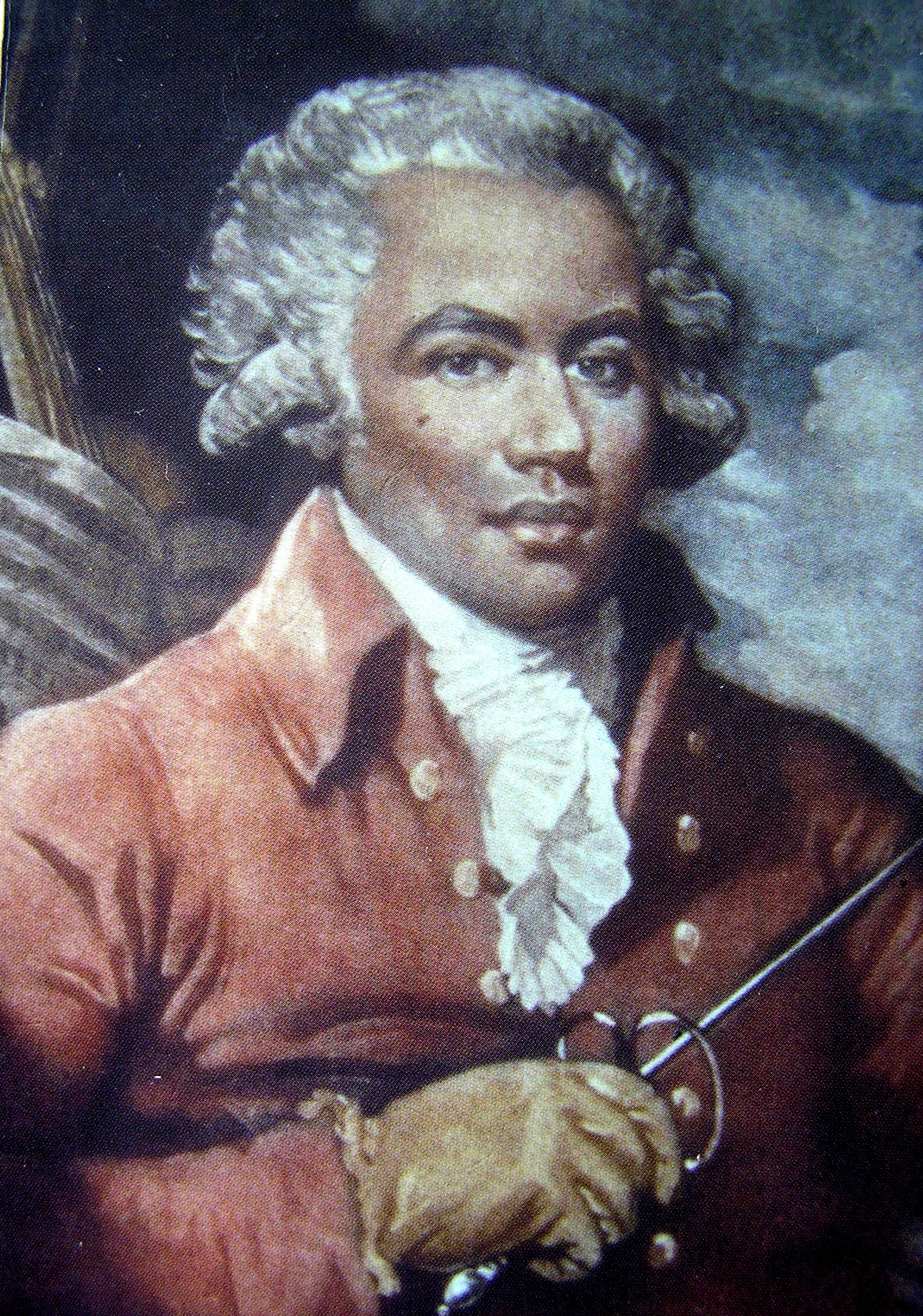 French colony on the island called Guadeloupe. Joseph was the son of a plantation owner, Pierre Boulogne. However, the plantation owner had Joseph out of wedlock. His mother was a slave who belonged to Pierre Boulongne’s wife. Her name was Anne Nanon. Anne Nanon was Sengalese. Throughout his life, Joseph struggled to fit fully into French society due to his mixed heritage.
Boulogne ended up moving quite a lot in his youth. He and his family eventually settled back down in France, though, where they knew that the prejudice towards people of mixed race would be less severe.
A Swordsman First. Joseph Boulogne began fencing when he was just 13 years old. X`He became known as Chevalier de Saint-Georges due to his talent as a swordsman. This name was given to him by Louis XV. Chevalier literally translates to Knight. He was also given the nickname ‘The God of Arms’ before he reached the age of twenty.
Early Compositions. Chevalier Saint-George began composing around 1770, when he was about 25 years old. Historians don’t know much about the beginning of his musical education. His early compositions were primarily string quartets. He also wrote several sonatas during this time. In 1772, he premiered his Violin Concertos in G (https://www.youtube.com/watch?v=rzITCuc4IbM)
Famous Connections. Saint-George went on to study with the French composers Gossec and Leclair. Gossec had created Concert de Amateurs, the group with which Saint-George initially premiered, and would later go on to conduct. But Chevalier’s connections with famous individuals didn’t end there. In 1779, he began to perform with Queen Antoinette (blackpast.org).
King Louis XVI’s Harsh Rule. Despite Chevalier’s wild success and performances with the queen, his life was far from easy. King Louis XVI was ruling at the time. While it is uncertain whether the King approved of Saint-George’s performances with the Queen, Louis XVI was expressly against abolishing slavery, and forbade interracial marriages. These strict laws would continue to be present throughout much of the composer's life. (Continue reading here).
Read more... « first ‹ previous … 88 89 90 91 92 93 94 95 96 … next › last »
Antoine Brumel - Sicut lilium
Ensemble I Buoni Antichi (Ensemble)
Coen Vermeeren (Conductor)