Welcome to our free classical music site

Do you write about classical music? Are you a blogger? Want to team up with Classical Connect? Send us a message, let's talk!
Do you write about classical music? Are you a blogger? Want to team up with Classical Connect? Send us a message, let's talk!




This Week in Classical Music: June 8, 2026. Schulhoff, hoaxes, and more. Robert Schumann was born this week, on June 8th of 1810. He is, obviously, one of the greatest Romantic composers of the first half of the 19th century; we love him and have posted many entries dedicated to him. Richard Strauss was born half a century later, at the end of the Romantic period, on June 11th of 1864. Tomaso Albinoni lived two centuries earlier: he was born in Venice on June 8th of 1671. In our time, he’s famous undeservedly: the most often performed piece of music, practically invariably attributed to him – the so-called Adagio in G minor – wasn’t written by Albinoni but by one Remo Giazotto, a musicologist and his biographer. It’s one of the most famous musical hoaxes, on par with “Ave Maria by Giulio Caccini,” composed by Vladimir Vavilov, “Sicilienne by Maria Theresia von Paradis,” written by Samuel Dushkin, and some pieces by Fritz Kreisler, who attributed them to numerous known and unknown composers. Surprisingly, the Adagio myth is still perpetuated by many performers, promoters, classical radio stations, and otherwise reputable musical organizations.
The composer we’d like to present today is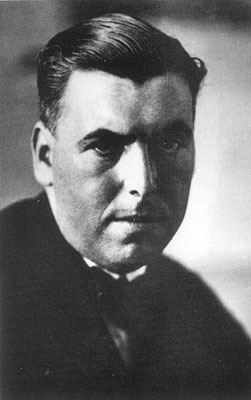 one of many musicians whose lives were catastrophically affected by the Nazis. Schulhoff was born in Prague, then part of Austria-Hungary, on June 8th of 1894. Like most Prague Jews of the time, his family was German-speaking (Kafka comes to mind, his friend Max Brod and the novelist Franz Werfel, all integral to German culture). A child prodigy, Schulhoff was noticed by Dvořák, studied with Smetana’s pupil, and went to Vienna to continue with the piano. A couple of years later, he moved to Germany, first to Leipzig, then to Cologne; he studied composition at the local conservatory, graduating in 1914 with prizes. At the beginning of the war, he was conscripted into the Austrian army and served for four years. The war politicized him, and Schulhoff turned to Socialism. In 1919, he moved again to Germany, this time to Dresden, where he had many friends. His early compositions were late-Romantic in style, but he was moving away from it. Two new directions affected Schulhoff: Dadaism, with its references to jazz, industrial noise, and rejection of tonality, and the Second Viennese School of Schoenberg. Two samples from the period give us a sense of how varied Schulhoff’s interests were: the Dada-influenced Ironien Op. 34, composed in 1920 (here), and the Schoenberg-affected Eleven Inventions, op. 36, written a year later (here). The pieces are as different as they are authentic, and we think, really good.
In 1923, Schulhoff returned to Prague and to the Czech musical tradition, changing his style again. He became a professor at the Prague Conservatory, befriended Janáček, and actively participated in the musical life of Czechoslovakia. Musically, he was moving toward neo-classicism, as we can hear in this piece, Concerto for String Quartet and Wind Orchestra from 1930, though the finale echoes his Dada period. Stravinsky was, clearly, a strong influence (here).
The last decade of Schulhoff’s life was sad. He became ever more active in politics, moving further left; he even wrote Das Manifest, a cantata on the text of the Communist Manifesto by Marx and Engels. In 1933, he visited the Soviet Union and embraced Stalin’s Socialist Realism. He didn’t compose anything interesting from that point on. And his political activism led to problems with the authorities. Things got much worse in 1939, when Nazi Germany invaded Czechoslovakia. Schulhoff tried to emigrate, either to the West or the Soviet Union, where his petition was approved. He never made it, as, in early 1941, he was arrested. In June of that year, he was deported to a prison in Bavaria. Three months later, he died of tuberculosis.Permalink
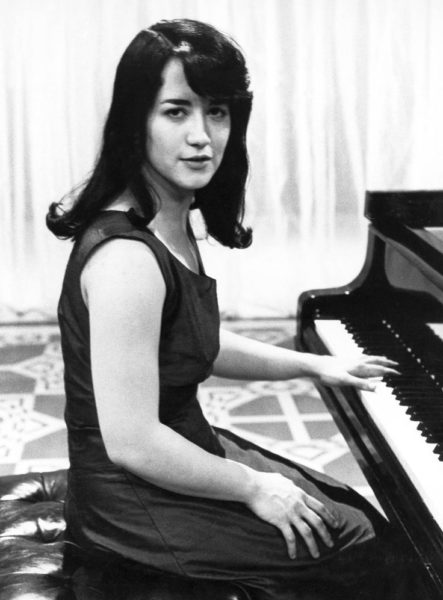 There’s no need to present the pianist Martha Argerich. If there is a superstar in the world of classical music, she’s it. Her career started in 1949, when at the age of eight, she played Beethoven’s Piano Concerto no. 1. At 19, she made her first commercial recording. Then, at 24, she won the VII International Chopin Piano Competition in Warsaw; this win catapulted her career into stardom, and since then, she has been one of the most sought-after pianists on the music scene. Even at 85, she performs scores of concerts a year: for example, at the end of June, she will play nine concerts in Hamburg. She stopped performing solo some years ago, but she will play several challenging pieces, for example, Beethoven’s 2nd, 4th, and 5th Piano and Violin Sonatas, with Maxim Vengerov. She’ll also play with the pianist Michail Pletnev, the violinist Gil Shaham and the cellist Mischa Maisky. We wish her many happy returns.
This Week in Classical Music: June 1, 2026. Two Important Anniversaries. Martha Argerich’s birthday is June 5th; she will turn 85, and June 6th is the 100th anniversary of Klaus Tennstedt, a German conductor.
Klaus Tennstedt was born in Merseburg, in the German state of Saxony-Anhalt. As a child, he studied the violin. At the end of WWII, he joined an orchestra and thus avoided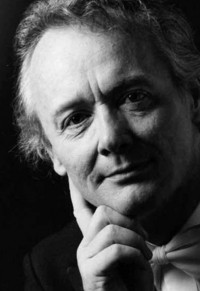 serving in the Nazi army. After the partition of Germany after the war, he ended up in the Russia-dominated East Germany. Tennstedt’s violin career was interrupted when he developed problems with his left hand, but he successfully transitioned to conducting. He started at the Chemnitz (then Karl-Marx-Stadt) opera, but soon after was appointed the Music Director at the more prestigious Dresden State Opera. For more than a decade, he was confined to working in the GDR and the Soviet bloc countries, but in 1971, during a rare appearance in Sweden, he defected. For several years, he lived in Sweden, conducting local orchestras. Then, in 1974, he appeared in North America, conducting the Toronto and then the Boston symphony orchestras. These concerts were very well received, especially his Bruckner’s Eighth, and were followed by invitations to conduct the Chicago Symphony, the New York Philharmonic, the Philadelphia Symphony, and other major orchestras in the US. His successes in the US led to his concerts with the Berlin and Vienna Philharmonic orchestras. Tennstedt led the London Philharmonic Orchestra for four years, but in 1984 his health started to fail. He gave a tremendous performance of Mahler’s Symphony no. 8 in 1987, but collapsed during a rehearsal later that year. He conducted several highly successful concerts in 1991 and 1992, and then stopped performing on the advice of his doctors. Tennstedt died of throat cancer in 1998. Here’s Mahler’s 8th: Part I, Veni, Creator Spiritus, and the longer Part II, Final Scene From Goethe's "Faust." Tennstedt conducts the London Philharmonic Orchestra and Choir, with Felicity Lott and other soloists (Dame Felicity Lott, a great soprano, passed away on May 15th of this year).Permalink
This Week in Classical Music: May 25, 2026. Post-Prokofiev Catching Up. We’ve posted four entries on Sergey Prokofiev and missed one week due to technical difficulties, so this week we’ll look back at what we’ve missed. And it was a lot, too many composers to write about, but we’ll mention the “highlights,” the names that are better known and more popular. Four names stand out: Johannes Brahms and Pyotr Tchaikovsky, both born on May 7th, the German in 1833, the Russian in 1840; Claudio Monteverdi (May 15, 1567), and Richard Wagner (May 22, 1813). Then there are the composers who, at least in the public opinion, are close to the top, but not quite within the ranks of the composers mentioned above: Alessandro Scarlatti (May 2, 1660); Gabriel Fauré (May 12, 1845); Jules Massnet (May 12, 1842); Ruggero Leoncavallo (April 23, 1857); Isaac Albeniz (May 29, 1860) and Erich Wolfgang Korngold also born on May 29th, of 1897; and Marin Marais (May 31, 1656). By the way, we believe that Alessandro Scarlatti very much belongs in the highest ranks. The reason his music isn’t performed more often has to do with logistics, not its quality: he wrote long operas that are difficult to stage, and there are few voices capable of singing the main roles (Cecilia Bartoli helped to revive some of his music). And, of course, many of his roles were written for the castrati. On the other hand, we think Marais’ popularity is due mostly to one film, Tous les matins du monde.
We also want to mention several modern composers who, these days, are not popular at all, as their music is considered too difficult and isn’t in vogue: the Italian Bruno Maderna and the American Milton Babbitt. Maderna was born on May 10, 1916, Maderna April 21, 1920. We think they’re very important and interesting composers, and hope that interest in them will return.
We want to circle back to Prokofiev for a moment. As we were reading about his life, one name was constantly coming up: that of his friend, Nikolay Myaskovsky. Myaskovsky, born on April 20th of 1881, was ten years older than Prokofiev. They met in 1906 in the St. Petersburg Conservatory: both were taking composition classes with Lyadov and Rimsky-Korsakov (and both didn’t like Lyadov). Myaskovsky was a late starter (his father, an officer, discouraged him from pursuing musical studies), and he ended up being the oldest student in the class; Prokofiev was the youngest. That didn’t stop them from becoming fast friends. They worked together on a symphony, now lost. During WWI, Myaskovsky was conscripted and fought as a sapper, while Prokofiev continued his conservatory studies, composed and performed in public. Prokofiev left Russia after the Bolshevik Revolution, while Myaskovsky stayed, but they kept in touch: altogether, they wrote more than 300 letters to each other. When Prokofiev returned to the Soviet Union in 1936, they resumed their friendship in person. Both suffered during Stalin’s “anti-formalism” campaign in 1947-48, but it was Myaskovsky who defended Prokofiev, Shostakovich and Khachaturian from the Communist Party criticism. He died in August of 1950, four years before Prokofiev.
Myaskovsky was prolific. He composed 27 symphonies, 13 quartets, nine piano sonatas and several choral pieces. His music, rather conservative in style, is not widely performed today, but during his lifetime, he was considered a preeminent composer, not only in the Soviet Union but also in the West. Here’s the first movement of Myaskovsky’s Symphony no 4, composed in 1918. Evgeny Svetlanov leads the Russian Academic Symphony Orchestra. Permalink
This Week in Classical Music: May 18, 2026. Prokofiev, Part IV. We finished our previous post with Prokofiev, his Spanish wife, and two sons arriving in Moscow in the summer of 1936..jpg "Sergey Prokofiev, by Konchalovsky") A shrewd man, Prokofiev should’ve known how dangerous it was, if not to him, then to his wife, who eventually ended up in the Gulag, serving eight years, but that didn’t stop him. Did he move back because he knew that his only real competitor, Dmitry Shostakovich, was silenced by the vicious criticism of the official press? We’ll never know, but we remember his problems with Rachmaninov in the US and Stravinsky in France.
A shrewd man, Prokofiev should’ve known how dangerous it was, if not to him, then to his wife, who eventually ended up in the Gulag, serving eight years, but that didn’t stop him. Did he move back because he knew that his only real competitor, Dmitry Shostakovich, was silenced by the vicious criticism of the official press? We’ll never know, but we remember his problems with Rachmaninov in the US and Stravinsky in France.
Prokofiev got plugged into the musical life of the Soviet Union instantly; it was as if he had lived there all his life. He wrote music to commemorate Pushkin’s 100th death anniversary, as was requisite in the midst of the national celebrations, pieces for children (one very successful, Peter and the Wolf, for a children’s theater), and a 10-part Cantata for the 20th Anniversary of the October Revolution, with texts from the works by Marx, Lenin, and Stalin. The latter wasn’t politically successful, as his music was judged “incomprehensible.” It was also just not very good. In 1939, Prokofiev followed the Cantata with Zdravitsa (Toast, or Hail), composed for Stalin’s approaching 60th birthday, a nauseating piece, but with streaks of Prokofiev’s talent. The text was purported to be “folkloric,” but was actually written by Kremlin's hacks. Prokofiev followed that with another Socialist Realist piece, the opera “Semyon Kotko,” which also failed to satisfy the Soviet critics. Till about 1940, or for the first four years of his life in the USSR, all his music was political, except for Romeo and Juliet and the first Cello sonata, both of which he started writing while still in France.
In 1941, as the Germans approached Moscow, he evacuated to safer areas, first to Georgia, then to Kazakhstan (Stalin moved to Kuibyshev). During that time, Prokofiev wrote several chamber and instrumental pieces, some of the best of his Soviet output: the three so-called “War sonatas” for the piano, nos. 6 through 8 (he premiered no. 6, Sviatoslav Richter played the first performance of no. 7, and Emil Gilels of no. 8). The Violin sonata no 1, premiered by David Oistrach, was also composed during that time. Of the large pieces, it was the ballet Cinderella, the music to Eisenstein’s film Ivan the Terrible, and the Fifth Symphony, probably his best.
Prokofiev’s relationship with his wife, Lina Llubera, had been failing for years, as he was involved with the young translator and librettist Mira Mendelson. He moved in with Mendelson in 1941, while still formally married to Lina, who wouldn’t give him a divorce. Artistically, though, things seemed to go well. Then, in February of 1948, two things happened: Andrei Zdanov, one of Stalin’s closest subordinates and the Soviet Union's chief propagandist, called a conference in the Kremlin where he scolded Prokofiev, Shostakovich, and Khachaturian as “formalists.” Zhdanov’s criticism wasn’t just words: at best, it could lead to a ban on one’s work, but things could get much worse; everybody remembers what happened to hundreds of cultural figures in the 1930s, who were criticized first and then disappeared in the Gulag or were shot outright. Zhdanov’s criticism affected Prokofiev the way the 1936 Pravda articles affected Shoskatkovich, but deeper: the young Shostakovich eventually recovered; Prokofiev, who was already in poor health, never did. He wrote a letter of self-criticism, repenting of his “formalism.” The self-flagellation didn’t stop the officials from banning many of his works. And then, that same month, Lina was arrested and sent to the Gulag for 20 years, and even though they had not lived together in years, the arrest deeply affected Prokofiev. He was only 53 in 1948, but from that point on, Prokofiev did not compose a single successful piece. He worked on revisions to his opera War and Peace and several other pieces, none of them significant. He suffered from terrible headaches and had several heart attacks. As his works weren’t performed in public, he had very little money. He died on the same day as Stalin, on March 5th of 1953, but his death went largely unnoticed; only several weeks later, there appeared a short obit at the back of a musical journal: the rest of the publication was dedicated to Stalin’s death.
Here’s Prokofiev’s Piano Sonata no. 8; it’s performed by the same pianist who premiered it in 1944, Emil Gilels. This recording was made 30 years later. Permalink
This Week in Classical Music: May 10, 2026. Technical issues. We were looking forward to publishing the final installment in our series of posts on Sergey Prokofiev, covering his life in the Soviet Union after his return to Moscow in 1936. Unfortunately, we encountered some technical issues and will have to wait till next Monday.Permalink
This Week in Classical Music: May 3, 2026. Prokofiev, Part III. As we mentioned in our previous post (here), even while living in Paris, Prokofiev continued to maintain relationships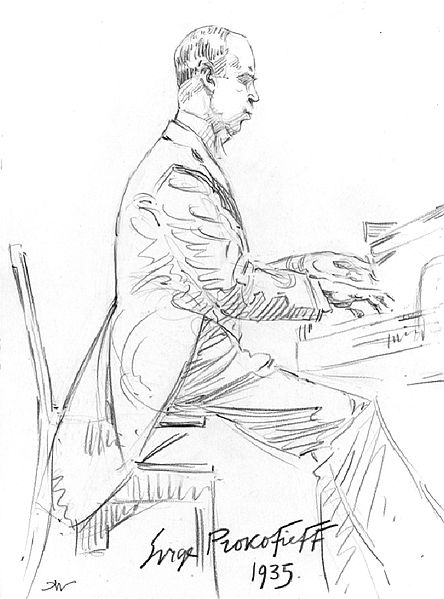 with Soviet musicians and music officials. He visited Soviet Russia for the first time in 1927, where he gave concerts in Moscow and Leningrad and oversaw the staging of The Love for Three Oranges in the Mariinsky theater. He also acquainted himself with the works of the young Shostakovich and Gavriil Popov, another talented composer. Several more trips followed, including the one to Moscow in 1929. But there were other ways in which Prokofiev maintained his relationship with Russia. For example, in 1926, he wrote a ballet Le pas d'acier (The Steel Step, an awkward name in English and no less so in Russian, Стальной скок). Commissioned by Diaghilev, who was impressed by the Russian futurist artists he saw at a Paris exhibition, the music, even if it borrowed from Stravinsky (and probably also from Arthur Honegger’s Pacific 231), already had all the attributes of a Soviet piece. The ballet was supposed to celebrate the Soviet industrial modernization; according to Richard Taruskin, its music made Stravinsky ill (we’re not that surprised). In 1929, Le pas d'acier was about to be staged at the Bolshoi, but the protests from the anti-Western Russian Association of Proletarian Musicians led to its withdrawal. Outside of musical affairs, there were other signs of Prokofiev's equivocations: for example, when France established diplomatic relations with the Soviet Union, Prokofiev elected to take Soviet citizenship.
Now a family man, he continued his existence in Paris; in 1930, he toured the US, this time quite successfully. All the while, Prokofiev contemplated the pros and cons of returning to the Soviet Union. His visits to Russia left him with no illusions about the political pressures on the arts in the country; what he was considering was whether he could use the politics to not just survive but flourish there, and how he would have to change his music to accommodate the art politics of the Socialist Realism, introduced by Stalin in 1932. He was ready to “simplify” his musical language, and, in the early 1930s, wrote several articles published in the Soviet newspapers, discussing such developments. He even composed several songs and choral pieces in a “folk” style, which were published and praised in Russia. The Soviets demonstrated their interest in Prokofiev by commissioning music for a film, Lieutenant Kijé. In 1935, he received a commission from the Kirov (formerly, Mariinsky Theater), which became the ballet Romeo and Juliet (the staging at the Kirov fell through; the ballet was premiered in Brno in 1938; the Soviet premiere had to wait till 1940, Galina Ulanova danced the Juliet).
It’s still a mystery why Prokofiev wanted to return to Russia. He was shrewd and by no means a political idealist. He knew the Soviet Union better than many of his fellow emigres. What made him think he would be impervious to Stalin’s terror? He knew that since the early 1930s, Stalin had brought all the arts under the control of the Communist Party. He knew what happened to Shostakovich when, in January of 1936, an article titled Muddle Instead of Music, was published in Pravda. It disparaged his opera Lady Macbeth of Mtszensk and called Shostakovich a “formalist” and “bourgeois.” A month later, another article severely criticized his ballet, The Limpid Stream. All this scared Shostakovich so much that for a while he stopped composing altogether. Prokofiev also knew about the treatment of the famous theater director Vsevolod Meyerhold or the poet Osip Mandelstam (both still alive in 1936, both to perish in the Gulag). So he knew that fame doesn’t protect anybody in Stalin’s Russia.
None of this stopped Prokofiev, and in the summer of 1936, he, his Spanish wife, and their two sons arrived in Moscow.
Here, from Prokofiev’s Paris period, is his Piano Concerto no. 4 for the left hand. It was composed in 1931 for the pianist Paul Wittgenstein, who lost his right hand in WWI. The soloist is Vladimir Ashkenazy; André Previn conducts the London Symphony Orchestra.Permalink