Welcome to our free classical music site

Do you write about classical music? Are you a blogger? Want to team up with Classical Connect? Send us a message, let's talk!
Do you write about classical music? Are you a blogger? Want to team up with Classical Connect? Send us a message, let's talk!




This Week in Classical Music: August 3, 2026. Summer. We are exactly one month into the dog days of summer, and classical music is not high on most people's priority list. And, clearly, it’s also not at Ravinia Festival, the country's oldest outdoor music festival. It used to be a summer venue for the Chicago Symphony, dedicated almost solely to classical music, with a small addition of jazz, usually at the end of the season. James Levine was the music director for twenty years, followed by Christoph Eschenbach and James Conlon. Marin Alsop is now in charge. There’s still some classical music being performed, and the Chicago Symphony is still there. For example, in ten days they’ll be performing the music of Quincy Jones. We didn’t make this up: for one evening, one of the world's best symphony orchestras will perform music by Quincy Jones. Don’t take us wrong: we understand that Mr. Jones was a very talented person, a great producer, a jazzman, and composer of many popular tunes. But somehow the idea of the Chicago Symphony being employed to play this feels wrong. Maybe Ms. Alsop could explain it better.
Guillaume Dufay was born on August 5th of 1397 (or at least that’s how his date of birth was reconstructed by musicologists). He’s one of the greatest composers of the early French-Flemish musical Renaissance, and one of the earliest composers who could be included in what we generally accept as “European musical canon.” The “canon” is, of course, a tenuous notion. We understand it in purely aural terms: Dufay’s music is difficult, its idiom sounds somewhat strange to a modern (especially untrained) ear, but still, it can be enjoyed, or at least appreciated. This is different from the reconstructed music of, say, Léonin and Pérotin, composers of the so-called Notre Dame school who worked at the end of the 12th - early 13th centuries. We think their music lacks some of the fundamental qualities of rhythm, pitch, overall complexity, and development that could be enjoyed today. On the other hand, we can imagine that for Dufay, their music belonged to his canon. To illustrate, here’s Dufay’s motet Nuper rosarum flores (The Rose Blossoms Recently), which Dufay composed in 1436 to celebrate the consecration of the Florence Duomo, officially known as Cattedrale di Santa Maria del Fiore (Cathedral of Saint Mary of the Flower; therefore, the rose in Dufay’s motet). Dufay’s polyphony sounds exotic but is musically understandable and enjoyable. And here is Viderunt omnes, Pérotin’s setting of a Gregorian chant, written sometime around the year 1200. It sounds (at least to our ear) as an auditory curiosity, a bit in the style of modern Minimalists, but outside the “canon.” We hasten to add that many listeners would argue that the music of Pierre Boulez, Karlheinz Stockhausen, and their brethren, composers of twelve-tone and serial music, is also outside of the classical “canon.” That’s an interesting topic to consider.
The American composer William Schuman and three French composers, Cecile Chaminade, Reynaldo Hahn, and André Jolivet, were also born this week (Hahn was born in Caracas, but his family moved to Paris when he was a child, and he spent the rest of his life there). Permalink
This Week in Classical Music: July 27, 2026. Two Tenors. Two weeks ago, when we celebrated Carlo Bergonzi, we also mentioned three great Italian singers of his time: Franco Corelli, Mario del Monaco, and Giuseppe Di Stefano. It so happens that Di Stefano’s birthday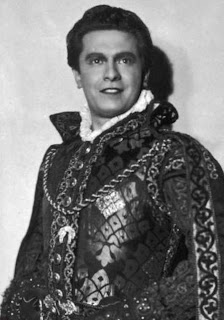 was three days ago, and Del Monaco’s is today.
Giuseppe Di Stefano was born on July 24th of 1921 in a small village near Catania, Sicily, but spent his youth in Milan. For many people, including Luciano Pavarotti, Di Stefano’s voice was of the utmost beauty, probably the most beautiful since the time of Beniamino Gigli. During WWII, the young Di Stefano was conscripted into the Italian (Mussolini’s) army. A medical doctor decided that he would be more useful as a singer than a soldier, which saved him from being sent to the Eastern Front and a likely death. He was eventually dismissed and allowed to sing professionally, first in local opera houses and then, after the war, internationally. Early in his career, he was a lyric tenor and sang lighter roles, such as Nemorino in L'Elisir d'Amore and Alfredo in La Traviata, adding heavier roles, such as Radames in Aida or Canio in Pagliacci only later. Many felt that heavier roles didn’t suit his voice as well. Di Stefano debuted at La Scala in 1948, and the same year he joined the Metropolitan Opera. In the 1950s, he often sang with Maria Callas at La Scala. Their Lucia di Lammermoor, Carmen, and La Traviata, with Karajan conducting, are legendary (he also sang with Callas’s great competitor, Renata Tebaldi). At that time, he made several recordings, also with Maria Callas. Their 1953 Tosca, with Victor de Sabata conducting, is considered one of the greatest ever made (the wonderful baritone Titto Gobbi was also in the recording in the role of Scarpia). Here is Di Stefano singing Ella mi fu rapita (She was stolen from me) followed by Parmi veder le lagrime (I seem to see tears), from Rigoletto. Parmi veder starts at 2:50 (see below).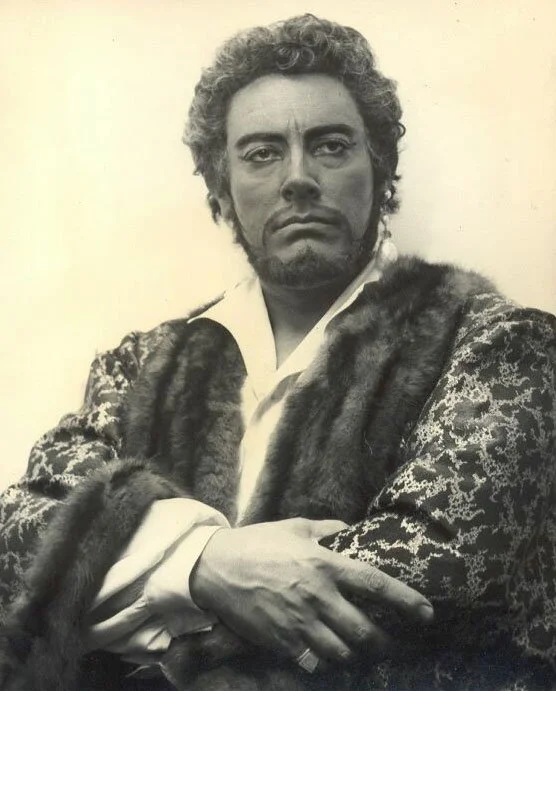
Mario Del Monaco’s voice, a dramatic tenor, could not have been more different from Di Stefano’s: it was of enormous power, much heavier, darker, not at all sweet but absolutely thrilling. Del Monaco’s most famous role was the one Di Stefano never attempted: Verdi’s Otello. Mario Del Monaco was born on July 27th of 1915 in Florence. He studied at the Conservatory in Pesaro and made his debut in 1939. He didn’t sing much during the war, but in 1945 his career took off when he sang Pinkerton in Puccini’s Madama Butterfly at La Scala (this became one of his signature roles). While his home stage was La Scala, he sang Aida in Arena di Verona, Tosca in London, Carmen in Rome, and then, famously, Otello in Buenos Aires. In 1959, he came to Moscow and became a sensation with the public and the authorities: Khrushchev gave him the Order of Lenin. During the 1950s, Del Monaco sang at the Metropolitan. He was in a car accident in 1963, which slowed him down. While Otello is Del Monaco's most famous role, we’ll hear him in more lyrical roles. Here’s an excerpt from Puccini’s La Fanciulla del West, with Renata Tebaldi. And here is Parmi veder le lagrime, from Rigoletto. How different is his voice from Di Stefano’s, and how beautiful in its own way!Permalink
This Week in Classical Music: July 20, 2026. Francesco Corteccia. To think of it, it’s rather strange that Florence was never a musical center of Renaissance Italy. It’s no surprise that Rome was the most important city, musically and in almost every other way. But Ferrara was also very important, as were Mantua and Milan. And so was Venice, of course. Florence, on the other hand, which was uniquely rich in practically every other way – its painters, sculptors, architects, poets, writers, philosophers were the best, or among the best, in Italy – didn’t have a comparable music culture. Things got better at the end of the 16th century, between the Renaissance and the Baroque, when opera was invented, and composers such as Jacopo Peri and Emilio de' Cavalieri worked on creating new musical idioms, but until that time, it was Francesco Corteccia who stood alone as the significant Florentine composer of the Renaissance. He was born in Florence on July 27th of 1502. He lived all his rather uneventful life in Florence. All his work was_Oil_on_wood_by_Angelo_Bronzino_-_Galleria_degli_Uffizi_-_Florence.jpg "Cosimo I de' Medici by Bronzino") dedicated to Duke (later, Grand Duke) Cosimo I de’ Medici, under whose patronage he worked most of his life. Corteccia was a choirboy at the Baptistry (the one next to the Duomo), where he eventually became the chaplain. He studied the organ at the Duomo and later worked there as maestro di capella. He also held the same position at the Medici family’s church of San Lorenzo.
dedicated to Duke (later, Grand Duke) Cosimo I de’ Medici, under whose patronage he worked most of his life. Corteccia was a choirboy at the Baptistry (the one next to the Duomo), where he eventually became the chaplain. He studied the organ at the Duomo and later worked there as maestro di capella. He also held the same position at the Medici family’s church of San Lorenzo.
Corteccia published three volumes of madrigals, his main secular output. He also wrote several intermedi, the sung interludes between the acts of plays; these intermedi eventually evolved into opera. The ones staged at the court were lavish, and the music was appropriately elaborate. As all composers of the time, he also wrote church music: motets, two Passions (St. John and St. Matthew, as Bach did two centuries later), hymns, and other pieces. We can hear two of Corteccia’s madrigals, Fammi pur guerr' amor (Make war on me, Love), here, and Io vorrei pur fuggir, crudel amore (I would truly want to flee, cruel love), here. And from Corteccia’s church music, Tenebrae factae sunt (Darkness fell) (here), followed by Caligaverunt oculi mei (My eyes are darkened), here. Corteccia died in Florence in 1571. We don’t have Corteccia’s portrait, but show instead the famous portrait of his patron, Duke Cosimo I, which was painted by the Italian Mannerist painter Bronzino sometime around 1545. Bronzino was born one year after Corteccia, in 1503, and died one year later, in 1572. Mannerism isn’t in vogue these days, but Bronzino was a great painter.
The Spanish composer Enrique Granados was born on July 27th of 1867; the Hungarian composer, pianist and conductor, Ernst von Dohnányi, exactly 10 years later. We have to admit that Dohnányi isn’t one of our favorite composers, but recently, for the first time, we heard his Sextet for Clarinet, Horn, Violin, Viola, Cello, and Piano and liked it a lot. You can listen to it here.
Of the performers, Leon Fleisher, one of the greatest among the American pianists, was born on July 23 of 1928, in San Francisco. He lost the use of his right hand to focal dystonia in 1964, but the recordings he made in the previous 15 years are priceless. Also, Isaac Stern, whom we mentioned in connection with Pinchas Zukerman’s birthday last week, was born on July 21st of 1920.Permalink
This Week in Classical Music: July 13, 2026. Henze at 100, Part II. We interrupted our story of Hans Werner Henze to celebrate America’s 250th anniversary, Mahler’s birthday, and some o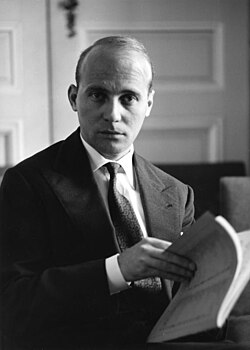 ther events, so now we’ll get back to the German composer, who, we admit, repulses and fascinates us at the same time.
In our first post, we stopped at the revolutionary year of 1968, when Henze was living in Italy and joined the Communist Party, then the largest in Western Europe; we also wrote about the scandal surrounding the premiere of his oratorio Das Floß der Medusa, dedicated to Che Guevara. Much of his music written during that period, even the instrumental pieces, were openly political, and the vocal music was much more so. His Sixth Symphony, which Henze composed while in Havana and premiered there, incorporates tunes from many leftist songs and marches, but if you listen to it, musically it’s a thoroughly modernist piece; one wonders how the Cuban communist authorities reacted to it: it’s no Socialist Realism. Still in Cuba, Henze followed up with El Cimarrón (The Runaway Slave), a long work for baritone, the guitar, flute and percussion, based on a highly politicized text by Hans Magnus Enzensberger, a fellow German. Again, politically it’s akin to Soviet agitprop, but again, musically an interesting piece. Some years later, when he was back in Italy, Henze wrote Voices, a cycle of 22 songs set to texts by Bertolt Brecht, the North Vietnamese leader Ho Chi Minh and others. Probably his most political work was the opera We Come to the River, based on an awfully violent libretto by the English playwright Edward Bond.
Henze’s work mellowed somewhat in the late 1970s, while remaining political. He wrote a Requiem in 1990, several operas and symphonies (his Ninth was choral, like the more famous one, and set to the text of Anna Seghers, a German communist writer who lived in East Germany). Henze also worked on promoting contemporary music: he founded festivals of new music in Montepulciano and Munich, taught composition in Cologne and at a workshop in Austria. Later in his life, he received many prizes and honors. Henze died in 2012, aged 86.
Here’s the second movement from Henze’s Symphony no 6, Lento. The Berlin Radio Symphony Orchestra is conducted by Marek Janowski.
We’d also like to note several birthdays that happen this week. Pinchas Zukerman will turn 78 on July 16th. He was born in Tel Aviv, went to music school there, and in 1961 was heard by Isaac Stern and Pablo Casals. Stern suggested that he go to Juilliard, and Zukerman moved to the US in 1962, with Stern serving as his legal guardian. While Zukerman was one of the best violinists of the last 60 years, he was also a great violist; he played this instrument in duos with Stern on several occasions. He often performed with his friends Daniel Barenboim, Jacqueline du Pré, Itzhak Perlman, and Zubin Mehta. Here’s Zukerman and Perlman joining Stern in Vivaldi’s Concerto for Three Violins celebrating Stern’s 60th anniversary. Zubin Mehta conducts the New York Philharmonic.
The Italian tenor Carlo Bergonzi was born on July 13th of 1924 near Cremona. He started as a baritone but eventually found his real voice, the tenor. He sang at La Scala, the Met (for 30 years), and at practically all other major opera houses. He performed at the same time as Franco Corelli, Mario del Monaco and Giuseppe Di Stefano during the golden age of Italian singing. His top notes may not have been as thrilling, but he was an excellent musician, and at his best, Bergonzi was on par with the greatest. Here’s his Celest Aida, recorded in 1975. The New Philharmonia Orchestra is conducted by Nello Santi. Permalink
This Week in Classical Music: July 6, 2026. 250th Anniversary, Alex Ross, Gustav Mahler (and Henze will have to wait). Fourth of July two days ago was a momentous event: the US turned 250. Classical music came rather late to this country, which, in its early years, was much more concentrated on fighting wars, building itself up, absorbing new immigrants, and growing in every way possible. There were few prominent American composers in the 19th century and none of the caliber of the Europeans of that time. Louis Moreau Gottschalk was one of the earliest, but he spent much of his life overseas and was more famous as a pianist than a composer. Arthur Foote, Victor Herbert, and Edward MacDowell wrote some interesting music, and of course, Amy Beach. Charles Ives was probably the first world-class composer born in the US. While there was a dearth of native composers, by the mid-19th century civic society had organized itself to create an environment conducive to public music-making. The oldest symphony orchestra, the New York Philharmonic, was created in 1842. Many more followed closer to the end of the century: St. Louis Symphony in 1880, Boston Symphony a year later, then Detroit Symphony (1887), Chicago Symphony (1891), Cincinnati Symphony (1895), Pittsburgh Symphony (1895), and Philadelphia Symphony in 1900. By the 20th century, the US, and New York in particular, became central to classical music. It was also a haven for musicians and composers fleeing turmoil in Europe, first the Russian Revolution of 1917, and then the Nazi takeover of Germany. We’re not going to recount the history of 20th-century music in America; suffice it to say, it was brilliant.
We’re afraid things are not as auspicious these days. Even though there’s a plethora of very talented musicians, classical music itself is in decline. The distance between the days when hundreds of thousands of pianos were sold every year to today, when sales of acoustic pianos are less than 1,800, is enormous. But it’s the loss of place in our culture that classical music has suffered in the last several decades, a loss that accelerated since 2020. It is a most consequential development, and this brings us to Alex Ross. Till last week, Ross was the music critic of The New Yorker magazine, probably the best music critic in the country, and clearly, the most famous one, especially now that the New York Times doesn’t have a permanent classical music critic on staff. Ross resigned his position on June 29th, citing his desire to stay closer to home (he lives in LA). He’ll continue with the magazine, writing about other cultural matters. Unfortunately, we don’t buy Rr. Ross’s explanation. We think that if he felt that his writings were still relevant, that they’re needed, he would’ve stayed. This is no longer the case. There was a time when musical events were displayed on the front page of the NY Times.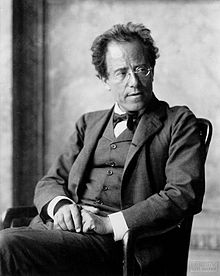 Today, even the best concerts don’t register. We’ve written about the decline of classical music many times and shouldn’t beat a dead horse, but Alex Ross’s resignation is highly symbolic. It closes a chapter.
Gustav Mahler, who was born on July 7th of 1860, is one of the greatest and most consequential composers in the history of music. For no fault of his own, he also became one of the most politicized figures. During the epidemic of wokeness/DEI that took over the country in 2020, his music practically disappeared from stage and radio waves. In a sign that wokeness is on a descent, his music reappeared and is being played again. Why Mahler’s music turned into such a litmus test is a mystery to us. Not that it was attacked directly, while even Beethoven himself was, but there’s something in his music that is incompatible with the woke establishment’s taste and perception.
If you want to listen to some of his music, please browse our library. Permalink
This Week in Classical Music: June 29, 2026. Henze at 100. July 1 will mark the 100th birthday anniversary of Hans Werner Henze, a prolific and talented German composer. He was born in Gütersloh, Westphalia, the eldest of the six children of a schoolteacher. And here we’ll digress. Several prominent 20th-century composers were active politically, and most invariably, on the left: for example, just three weeks ago, we wrote about Erwin Schulhoff, an Austrian-Czech composer who turned radically left late in his career and accepted Stalin’s Socialist Realism as his credo. He’s remembered, and rightfully so, as a victim of Nazism, but that doesn’t negate his objectionable politics. Hanns Eisler was part of the Left from an early age in Germany. The Nazi takeover brought him to the US, the Red Scare sent him back to Europe, and he ended up as an official composer of communist East Germany. Henze belonged to the same group of hard-left acolytes, and his politics affected much of what he wrote during his life.
The young Henze grew up under the Nazis, with his father indoctrinated by Nazi propaganda. Like many German kids of his age, Henze enrolled in the Hitler Youth group. Hans was sent to a music school in 1942, but eventually both he and his father ended up in the army: the father volunteered, Hans was conscripted. His father was killed on the Eastern Front. Hans served as a radio operator, was captured by the British, and placed in a camp for a year until the end of the war. After the war, Henze, by then a budding composer, attended the Darmstadt school and festival, the major center for new music in Europe, and became involved with post-classicism (in the Hindemith style) first, and then with the twelve-tone technique and serialism.
For the next several years, Henze composed for the stage, creating several operas and ballets; he also served as ballet conductor in Wiesbaden. In 1953, Henze, who was gay, decided to move to Italy, partly because of the perceived (or real) homophobic atmosphere in Germany, partly because of the country's more conservative culture in general. In Italy, he continued writing for voice, operas and songs, and some instrumental music as well. He also became much more active politically, joining the Italian Communist Party. In Italy, he met Ingeborg Bachmann, an Austrian poet and radical philosopher. She wrote librettos to several of Henze’s operas, including Der Prinz von Homburg (The Prince of Homburg), probably Henze’s most popular opera; he also set her poems to music. In 1957, he created a piece for soprano and orchestra based on Bachmann’s poem, called Nachtstücke und Arien. Here is Nachtstücke I, the first movement of the piece.
In 1967, he wrote the oratorio Das Floß der Medusa (The Raft of the Medusa), and dedicated it as a requiem to the Cuban revolutionary Che Guevara. The premier, in Hamburg in December of 1968, turned into a political scandal. Before the performance even started, radical students hung a large poster of Che and a red flag. Then the anarchists added a black flag. The choir refused to sing under these flags and left the stage; the police were called to remove the students, and in this chaos, the performance was canceled. Here’s a four-minute fragment from the Floß, with Dietrich Fischer-Dieskau singing and Henze himself conducting. The recording was made in the same revolutionary year of 1968.
We’ll finish the story of this fascinating composer next week. Permalink