
Beethoven, 2018
December 10, 2018. Beethoven. This second week of December almost always presents us with problems, and this is no exception. Early in the week we have three French (or, rather, French-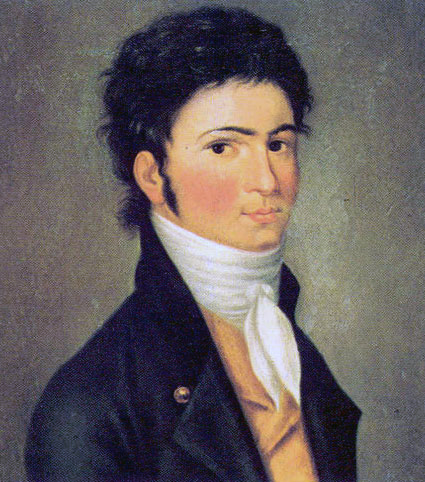 speaking) composers, and then, closer to the end, is Beethoven. We’ll write about César Franck, Hector Berlioz and Olivier Messiaen next week, as we cannot really skip over Beеthoven’s anniversary. Ludwig van Beethoven was born, we assume, on December 16th of 1770. Considering the time and place (the second half of the 18th century and Bonn, a small but important city, the seat of the Archdiocese of Cologne), it is strange that we don’t have a record of his birth; we only know that he was baptized on the 17th, which was usually done the next day after the birth of a child We’ve followed Beethoven’s life by his piano sonatas, an arbitrary choice but one that helps us concentrate on different periods of his life. Last year we stopped at his Sonata no. 10, Op. 14, written in 1798-1799. Sonata no. 11 was composed in 1800 and carries the opus number 22. Between these sonatas, Beethoven wrote six (!) string quartets, Piano concerto no. 1, published the Piano concerto no. 2, which was composed some five years earlier, and the First symphony. This incredibly productive period was not easy. On the one hand, by 1800 Beethoven became well established in Vienna, roundly acknowledged as the most talented composer since Mozart and Haydn; he had wealthy patrons, among them Prince Karl Alois Lichnowsky, a Chamberlain at the Imperial court and the former patron of Mozart, and Prince Lobkowitz, a major patron of Haydn. On the other hand, he was already developing severe hearing problems. It appears that the first episode happened as early as 1798, when Beethoven temporarily lost his hearing. Even after he recovered, he couldn’t get rid of the ringing in his ears, and his hearing was slowing declining.
Beethoven was very proud of his Piano Sonata no. 11, op. 22, considering it his best up to that point, even if these day’s it’s not performed as often as some other piano sonatas, even from the same period. It’s a “grand” sonata, meaning that is has four, rather than three, movements: Allegro, Adagio, Menuetto, and Rondo: Alegretto. No. 11 is also the last of Beethoven’s classical sonatas, written in the style previously developed by Haydn and Mozart. Beethoven dedicated it to Count Johann Georg von Browne, a Russian officer of Irish descent, who moved to Vienna in 1794 and was one of Beethoven’s early patrons. The sonata is played here by Wilhelm Kempff, one of the greatest German pianists of the 20th century. This recording was made in 1965, when Kempff was 70.
Later in 1800, Beethoven started working on the next piano sonata, no. 12, which received opus number 26: in the interim, Beethoven composed two violin sonatas, one of which, no. 5, “Spring,” is a masterpiece, and a Serenade for Flute, Violin and Viola. Piano sonata no. 12 also has four movements and, unusually for a classical sonata, starts with an Andante, a slow movement representing a theme and variations. The theme is strikingly similar to the one Schubert used 27 years later in his Impromptu No. 2 in E-flat major. One wonders if it was an explicit homage or a subconscious borrowing. The third movement Maestoso andante, subtitled Marcia funebre sulla morte d'un eroe is a poignant funeral march. The sonata is performed by another great interpreter of the music of Beethoven, American pianist Richard Goode.
Read more...Ludwig van Beethoven - Piano Sonata no. 11 op. 22 in B-flat major
Wilhelm Kempff (Piano)
Aaron Alter - Solar Rays for Piano, Violin and 'Cello
Susan Merdinger (Piano)
Michaela Paetsch (Violin)
Thor S. Sigurdson (Cello)
Mieczysław Weinberg, 2018
December 3, 2018. Mieczysław Weinberg. The Polish-Jewish-Soviet composer Mieczysław Weinberg is known by many names: his first name is sometimes spelled Moisey, his last name 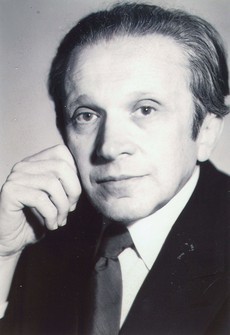 Vainberg, Vajnberg or Vaynberg. The problem is that, no matter how his name is spelled, the public doesn’t know his music. It’s a pity, as he deserves better. He was born Mojsze Wajnberg on December 9th of 1919 into a Jewish family in Warsaw. His father wrote music for Yiddish theaters. His mother was an actress in the same theaters. Mojsze (or Mieczysław in Polish) studied piano at the Warsaw Conservatory, graduating in 1939. On September of that year the Nazis entered Poland starting WWII and Weinberg fled to the Soviet Union. It was often the case at the time that Jewish families sent their older sons away first, hoping to join them later. Unfortunately, his parents and younger sister never made it out of Poland and eventually perished in a concentration camp. Weinberg settled in Minsk and went to the local Conservatory, where he studied composition. In 1941 Germany attacked the Soviet Union; the Minsk Conservatory was evacuated to Central Asia and Weinberg found himself in Tashkent. There, he met and eventually married Natalia Vovsi, daughter of the famous Yiddish actor and director Solomon Mikhoels (Mikhoels was his stage name, he was born Shloyme Vovsi). In 1943 Weinberg sent the score of his First Symphony to Dmitry Shostakovich. Shostakovich was impressed and arranged for Weinberg to be invited to Moscow; they soon became good friends.
In January of 1948 his father-in-law, Solomon Mikhoels, one of the most prominent Jews of the Soviet Union, the chairman of the Jewish Anti-Fascist Committee who traveled the world encouraging support for the Soviet Union, was assassinated on Stalin’s orders. The murder was covered up as a road accident. At the time of Stalin’s campaign against “cosmopolitanism” (read anti-Jewish, antisemitic campaign) that followed, all prominent Jews were at risk. Weinberg was no exception: in February of 1953 he was arrested as a “Jewish bourgeois nationalist” and sent to the Gulag. Shostakovich, who wasn’t known for his civic courage, sent a letter to Lavrentiy Beria pleading his friend’s innocence (it didn’t help). Weinberg and many other Jews were saved by Stalin’s sudden death in March of 1953. Weinberg was allowed to return to Moscow. His family found a place not far from Shostakovich’s apartment; they visited each other often. Weinberg continued composing; his work, championed by Shostakovich, was also endorsed by several prominent performers and conductors, among them Emil Gilels, Leonid Kogan, Mstislav Rostropovich, Rudolph Barshai and Kirill Kondrashin. Weinberg died in Moscow on February 26th of 1996; shortly before death he converted to Orthodox Christianity.
Weinberg is sometimes dismissed as the “smaller Shostakovich.” It’s true that he borrowed some idioms from his great compatriot and in some pieces quoted him directly, but Weinberg was a talented original composer, a wonderful melodist also capable of sophisticated orchestration. He wrote seven operas; the best known, The Passenger, has been staged at the English National Opera, the Lyric Opera of Chicago and many other stages. He also wrote 22 symphonies and many chamber works. Here’s the second movement, Lento, from Weinberg’s Symphony no. 1, composed in 1942 in Tashkent, the one that so impressed Shostakovich. Gothenburg Symphony Orchestra is conducted by Thord Svedlund.
Read more...Mieczysław Weinberg - Symphony no. 1, 2nd mov. Lento
Gothenburg Symphony Orchestra (Orchestra)
Thord Svedlund (Conductor)
Ludwig van Beethoven - Cello Sonata No. 3 in A Major, Op. 69
Thomas Mesa (Cello)
Alexandra Joan (Piano)
Claude Debussy - Sonata for Cello and Piano
Thomas Mesa (Cello)
Alexandra Joan (Piano)
Joaquín Nin - Spanish Suite (Selections)
Thomas Mesa (Cello)
Alexandra Joan (Piano)
Lully, Donizetti, Callas 2018
November 26, 2018. Lully, Donizetti, Callas. Jean-Baptiste Lully was born this week, on November 28th of 1632. He’s the first of the great French Baroque composers – Couperin and Rameau followed, each a generation younger. When Lully was accepted at the court of Louis 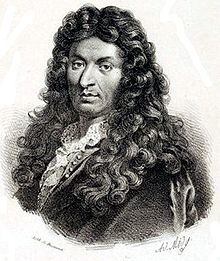 XIV, first as a dancer, then as composer, French music was in a temporary decline. The Italians were way ahead, developing the new Baroque style: Monteverdi, the “father” of the opera, was one of the very first to cross the line between Renaissance and Baroque; Girolamo Frescobaldi adapted the new style to his music for the clavier; Giacomo Carissimi, Tarquinio Merula and Salamone Rossi were among the early adopters. Francesco Cavalli and Antonio Cesti followed Monteverdi in the development of opera. There were many more – Italy was bursting with musical talent. The French just couldn’t compare – that’s till Lully, an Italian who took French citizenship once the King gave him the most important music position in the realm, that of the surintendant de la musique de la chambre du roi, the superintendent – the manager and organizer – of music in the King’s chambers. And at the court, Lully was really in charge of everything music-related. He had two composers working for him, supervised several ensembles, including the famous Twenty-Four Violins of the King, and other musicians. He also composed. In 1664 he met Molière, with whom he created several comédies-ballets. Most of them were premiered at the court and then played in Paris theaters. Lully even became known in Italy: the Grand Duke of Tuscany asked him to write several dances in the “fashionable style.” All this work brought Lully a lot of money, and in 1670 be built himself a splendid house on the corner of rue Sainte-Anne and rue des Petits Champs (the house was so expensive that he still had to borrow 11,000 livres from Molière). The building still exists. Here’s a short Prelude to Psyché, a play by Molière. William Christie conducts Les Arts Florissants.
Gaetano Donizetti was born on November 29th of 1797 in Bergamo. He studied in a local school established by a German opera composer Simon Mayr, who moved to Bergamo and was appointed the maestro di cappella at the Cathedral of Bergamo. Gaetano was one of Mayr’s favorite pupils, and Mayr even secured a scholarship for him to study in Bologna. In 1821 Donizetti, a fledgling composer, moved to Rome. There he wrote hist first successful opera, Zoraida. A year later he moved to Naples and stayed there for 16 years. It was during that period that he wrote most of his masterpieces. The first was Anna Bolena, written in 1830. It premiered in Milan, in Teatro Carcano; the success was overwhelming. Giuditta Pasta sung the title role. Pasta, a mezzo who sung soprano roles, one of the greatest singers of her time (Bellini wrote the role of Norma with her in mind). Nowadays, musicologists compare her to Maria Callas. It just so happens that Maria Callas’s birthday is also this week! She was born on December 2nd of 1923 in New York to Greek parents. Here’s an outstanding performance by Callas in the Mad Scene from Anna Bolena. In the 20th century Donizetti’s masterpiece was almost forgotten, partly because the main role is so demanding; Pasta brought Anna Bolena to life, Callas’s performance at La Scala in 1957 helped to revive it. In this studio recording, made one year later in London, Nicola Rescigno is conducting the Philharmonia Orchestra. We can only guess if Giuditta Pasta was as good.
Read more... « first ‹ previous … 164 165 166 167 168 169 170 171 172 … next › last »
Ludwig van Beethoven - Piano Sonata no. 12, op. 26 in A-flat major
Richard Goode (Piano)