
Berg, Leinsdorf, Björling 2019
February 4, 2019. Berg, Leinsdorf, Björling. We have three anniversaries this week, that of a composer, a conductor, and of a tenor. The composer is Alban Berg, born on February 9th of 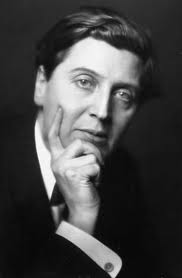 1885 in Vienna. One of the greatest modernists of the 20th century, he is mostly known for two groundbreaking operas: Wozzeck, the first atonal opera of the 20th century, which Berg completed in 1922, and Lulu, which he started in 1929 and worked on for the next seven years till his death in 1935, still leaving it incomplete. The libretto for Wozzeck Berg wrote himself, following Georg Büchner’s play Woyzeck; Berg also wrote the libretto for Lulu, this time based on the play, Erdgeist, by another famous German playwright, Frank Wedekind. By the time of Berg’s death, anti-Semitism was rampant not just in Nazi Germany but in Austria as well. Berg’s “problem” was that he was a student of Arnold Schoenberg, a Jew. Wozzeck stopped being performed in 1932, and all of Berg’s music was prohibited in Germany in 1935 as “degenerate music.” Wozzeck, as complex as it was, proved that an atonal work could bring enough auditory, rhythmical and emotional dynamics to keep listeners rapt for 100 minutes. Lulu was even more difficult and, at approximately three hours, much longer. It was premiered, in its incomplete form, in 1949: Berg’s widow, Helen, wanted Schoenberg to complete the score but the master declined; Helen wouldn’t let anybody else touch it. Following Helen Berg’s death in 1976, Austrian composer Friedrich Cerha completed the orchestration of the 3rd act. The first performance of the complete opera took place in Paris’s Palais Garnier in 1979 with Pierre Boulez on the podium. This became the standard version, performed in major opera houses. Here are five minutes from Act III ("Wer ist das?" – “Who is this?”). Teresa Stratas (she was one of the best Lulus on the opera scene) sings the role of the protagonist; Franz Mazura is Jack. Pierre Boulez conducts Orchestre de l'Opéra de Paris.
Erich Leinsdorf was also born in Vienna, on February 4th of 1912. As a young conductor, he assisted Bruno Walter and Arturo Toscanini at the Salzburg Festival for three years, from 1934 to 1937. In November of 1937, Leinsdorf, who was Jewish, traveled to the United States. Four months later, Nazi Germany took over Austria in the infamous Anschluss; Leinsdorf stayed in the US and became a citizen in 1942. Leinsdorf had led several major American orchestras, from the Cleveland to the Boston, he also had a long association with the Metropolitan opera. Here is Overture and Venusberg Music from Wagner’s Tannhäuser. Erich Leinsdorf leads the Boston Symphony Orchestra in the 1964 recording.
Jussi Björling was one of the supreme tenors of the 20th century. He was probably the only non-Italian who was an equal to the greatest Italian tenors in the Verdi repertoire. Björling was born in the town of Borlänge in central Sweden on February 5th of 1911. He made his professional debut at the Royal Swedish Opera in 1930. Recognition came to him early: in 1936 he debuted at the Vienna Opera, and one year later he sung in Chicago. He first performed at the Met was in 1938 and at the Covent Garden – in 1939. Björling had an exceptionally beautiful voice which had an amazing consistency from the top to bottom of his register. Björling’s life was tragically short: he died at the age of 49 after suffering a heart attack during a performance of La Boheme at Covent Garden six months earlier (he completed the performance). Here’s Jussi Björling in the aria Una furtiva lagrima" from Act II of L'elisir d'amore by Gaetano Donizetti. This recording was made in December of 1947.
Read more...Richard Wagner - Overture and Venusberg Music from Tannhäuser
Boston Symphony Orchestra (Orchestra)
Erich Leinsdorf (Chorale)
Alban Berg - Wer ist das?, from Lulu, Act III
Franz Mazura (Baritone)
Teresa Stratas (Soprano)
Orchestre De L'Opéra De Paris (Orchestra)
Pierre Boulez (Conductor)
5+4, 2019
January 28, 2019. Old and new; composers and performers. This week has so many anniversaries that they turn our post into a list, but we’d rather that than omit anybody. Five composers were born this week; they span two and a half centuries, from the Baroque to today. The oldest is Alessandro Marcello, born on February 1st of 1673. His younger brother, Benedetto Marcello, is better remembered these days, but Alessandro’s Oboe Concerto (here) was good enough for Bach to transcribe it for the keyboard solo; we now know it as Bach’s Concerto BWV 974.
Franz Schubert was born on January 31st of 1797 in Himmelpfortgrund, now part of Vienna’s 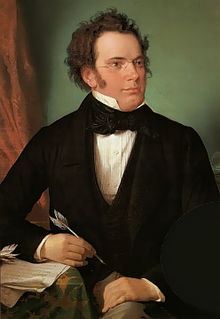 9th district. Undoubtedly one of the greatest composers in the history of European music, he wrote, during his short thirty-one-year life, an astounding number of masterpieces. In their profundity, his late piano sonatas could be compared only to those of the late Beethoven. His symphonies are among the best in the 19th century literature, his sacred works are very interesting, but it’s the Lieder, the art songs, that truly set him apart. His song cycles, Die schöne Müllerin, Winterreise, Schwanengesang, are works of pure genius. And so are some individual songs. Here, for example, is An Sylvia. It’s sung by a young American mezzo, Clara Osowski. Mark Bilyeu is on the piano.
Felix Mendelssohn was also born this week, on February 3rd of 1809. We just talked about Schubert; Mendelssohn was one of the key people who promoted Schubert’s music which – inexplicably – faded from people’s memory soon after Schubert’s death. He, for example, premiered Schubert’s Symphony no. 9 in 1839 (the manuscript was discovered by Robert Schumann). You can read about Mendelssohn here and here. We understand that Mendelssohn, one of the greatest composers of the 19th century, deserves much more, and we’ll try another time. For now, here’s Mendelssohn’s String Quartet No. 6 in F minor, Op. 80. It’s his last large-scale work and was completed in September of 1847, as a “Requiem” for his beloved sister Fanny, who died in May of that year. Felix would be dead two months later, on November 4th of 1847. The performers are the Artemis Quartet.
Two very different modern composers were also born this week: John Tavener and Luigi Nono, Tavener on January 28th of 1944, Nono – on January 29th of 1924. Their art is a testimony to the tremendous depth and diversity of modern music. Tavener, a deeply devout man (he converted from the Presbyterian to the Orthodox church) wrote mostly religious music. In its stillness, the music of Tavener reminds us that of Arvo Pärt. Here’s his The Last Sleep of the Virgin for a String quartet and handbells. It’s performed by the Chilingirian Quartet and Iain Simcock, a composer and organist, playing the bells. Luigi Nono was a very different kind of composer: a dedicated avant-gardist, he was close to his Darmstadt fellows such as Karlheinz Stockhausen and Pierre Boulez. Here’s an example of his work, a suite from Prometeo, a theatrical work, which could be called opera or a set of oratorios, though Nono disliked typecasting his compositions. Claudio Abbado leads the Lucerne Festival Orchestra and soloists.
Four great performers were also born this week. None of them need an introduction: Arthur Rubinstein, on January 28th of 1887, Fritz Kreisler – on February 2nd of 1875, Jascha Heifetz – on the same day but in 1901, and Renata Tebaldi, the great soprano and Maria Callas’s rival – on February 1st of 1922.
Read more...Ken Abbott - piano delight
ken abbott (Piano)
John Tavener - The Last Sleep of the Virgin
Chilingirian Quartet (Quartet)
Felix Mendelssohn - String Quartet f-minor No. 6 Op. 80
Artemis Quartet (Quartet)
Mozart and more, 2019
January 21, 2019. Mozart and more.Wolfgang Amadeus Mozart was born this week, on January 27th of 1756. We write about him regularly – it couldn’t be otherwise as Mozart is 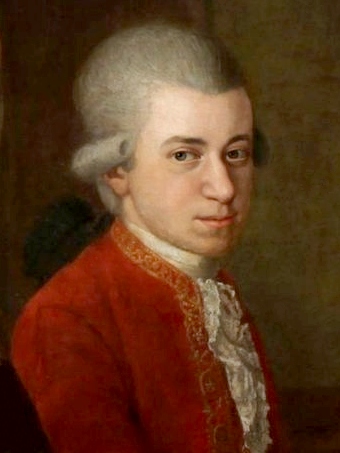 the seminal figure in the history of Western music. So this time, to celebrate Mozart we’ll play a celebratory music composed by Mozart himself. The story of this piece starts with the Haffners, a prominent Salzburg family whom Mozart knew well. Sigmund Haffner the Elder was the mayor of Salzburg; Sigmund Haffner the Younger was Mozart’s friend. In 1776 Haffner Jr. commissioned Mozart to write music for the wedding of his sister, Marie Elisabeth. Mozart came up with a Serenade in D Major (K. 250), which we know as Haffner Serenade. Six years later the occasion was the ennoblement of Sigmund Haffner himself. Again, Mozart was asked for a musical accompaniment, and even though Mozart was very busy at the time, he composed yet another serenade, except that he didn’t stop there but developed the serenade into a symphony, which we know as Symphony No. 35 in D major, K. 385, Haffner. Here it is, performed by the Academy of St. Martin in the Fields under the direction of Iona Brown.
Several talented musicians were also born this week. Wilhelm Furtwängler, one of the most important conductors of the 20th century, was born on January 25th of 1886 in Schöneberg, a district of Berlin. Furtwängler is such an immense and complicated figure that we would need more than one entry to even begin to describe him. So for now, here’s a brief sketch of the first half of his life. Even though he was born in Berlin, Furtwängler spent his childhood in Munich, were his father, a prominent archeologist, received a professorship. When it became obvious that Wilhelm is an extremely gifted child, his parents took him out of public school and hired tutors to educate him privately.
He learned to play the piano at an early age; he started composing at the age of seven. (Most of his life he thought of himself as a composer first and conductor second – he started conducting in order to perform his own works. The public and the critics disagreed). From the beginning of his conducting career it was Beethoven who interested him the most. Starting at 1905, he guest-conducted in Breslau, Zurich, the Munich Hofoper and the Strasbourg Opera. In 1911, at the age of just 25, he was appointed the director of the Lübeck Opera, where he worked for four years. Then, from 1915 to 1920, he directed the Mannheim Opera. In 1920, Furtwängler succeeded Richard Strauss as the director of the Berlin Staatskapelle, the orchestra of the Berlin State Opera. He also conducted the Frankfurt Museum concerts following the departure of Willem Mengelberg. When Arthur Nikisch died in 1922, it was only natural that Furtwängler succeed him at the Leipzig Gewandhaus Orchestra and the Belin Philharmonic. These were some of the most coveted conducting positions in the world, but the most creative (and controversial) phase of his career was only beginning. Here’s a recording of The Siegfried Idyll, music that Wagner wrote as a birthday present for his wife Cosima in 1869 and later incorporated into his opera Siegfried. Furtwängler leads RAI National Symphony Orchestra (Italians playing Wagner!), the recording quality is not terribly good even though it was made in 1952, but the performance is alive, it breathes, moves forward, despite (or is it because of?) Wagner’s endless repeats.
Also, two great British performers, whose careers were tragically short, were born this week. Jacqueline du Pré whose recording of Elgar’s concerto is a classic, was born on January 26th of 1945. She stopped playing in 1971, at the age of26, and was diagnosed with multiple sclerosis two years later. She died on October 19th of 1987. John Ogden, a pianist, was born on January 27th of 1937. Ogden shared the First prize with Vladimir Ashkenazi at the 1962 Tchaikovsky competition. He had a mental breakdown in 1973, spent the following 10 years in a hospital and after that performed only sporadically. Ogden died on August 1st of 1989.
Read more...Richard Wagner - Siegfried Idyll
Orchestra Sinfonica di Torino della RAI (Orchestra)
Wilhelm Furtwängler (Conductor)
Gaetano Donizetti - Una furtiva lagrima, from L'elisir d'amore
Jussi Björling (Tenor)
Stockholm Concert Association Orchestra (Orchestra)
Nils Grevillius (Conductor)