
Wolfgang Amadeus Mozart - String Quartet No. 22 in B-flat Major, K. 589 "Second Prussian Quartet"
Tesla Quartet (Quartet)
Franz Schubert - String Quartet No. 12 in c minor, D. 703 “Quartettsatz”
Tesla Quartet (Quartet)
Schumann’s Dichterliebe, Part II
June 22, 2015. Schumann’s Dichterliebe, Part II. In the absence of any significant birthdays this week we decided to publish the second part of the article on Robert Schumann’s song cycle Dichterliebe (A Poet's Love). The first part was published here. As a reminder, Dichterliebe, o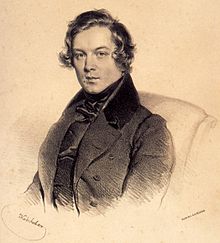 n texts by Heinrich Heine from his Lyrisches Intermezzo, was written in 1840. That was the year Schumann married Clara Wieck; it also turned into his Liederjahr – the year of songs: he wrote almost 140 of them in a tremendous creative spurt. Dichterliebe is probably the best known. To illustrate the cycle, we used recordings made by Fritz Wunderlich. All but the one were made in Salzburg in 1965. The recording of Die alten, bösen Lieder was made during a concert in Usher Hall, Edinburgh, on August 4th of 1966. Wunderlich tragically died just one month later; he was 35 years old. ♫
The poet’s state becomes even more pitiful in “Das ist ein Flöten und Geigen” (“There is fluting and fiddling,” here) as he witnesses the joyous festivities of the marriage of his beloved to another man. He gazes upon the merriment, watching her dance (“Da tanzt wohl den Hochzeitreigen / Die Herzallerliebste mein”) to the sound of flutes, fiddles, shawms, and drums. Betwixt the sounds of the instruments, the angels weep for the lonely poet (“Dazwischen schluchzen und stöhnen / Die guten Engelein”). Schumann’s setting portrays the dance of the beloved and her wedding guests. However, its D minor tonality and chromatic harmonies undoubtedly identify that the listener is viewing the scene through the prism of the poet’s broken heart.
Utter despair sets in the following song, “Hör’ ich das Liedchen klingen” (“I hear the dear song sounding,” here). Pained by watching his beloved married to another, the poet now hears the sweet song she once sang, a symbol that her love is forever no longer his. In his desolation, he seeks the solace of nature, wandering deep into the forest to weep. Schumann’s setting is through-composed in the key of G minor. The doleful vocal melody closes first in the key of the subdominant at the conclusion of the first stanza, poignantly affected by a Neapolitan sixth. The second stanza then slowly descends back to the tonic of G minor. Against the vocal melody is an accompaniment of descending arpeggios, which with the song’s slow tempo depict the falling tears of the poet. As with many of Schumann’s song, the climax comes as the vocalist exits. Shadowing the final notes of the melody, the piano begins a heartrending coda which culminates as chromatically ascending harmonies beneath a tonic pedal suddenly break into a descending passage of sixteenth notes through almost three octaves. Here, the listener beholds the poet’s heart bursting with pain (“So will mir die Brust zerspringen / Vor wildem Schmerzendrang”). (Continue reading here)
Read more...Robert Schumann - Die alten, bösen Lieder, from Dichterliebe, Op.48
Fritz Wunderlich (Tenor)
Hubert Giesen (Piano)
Robert Schumann - Aus alten Märchen winkt es, from Dichterliebe, Op.48
Fritz Wunderlich (Tenor)
Hubert Giesen (Piano)
Robert Schumann - Allnächtlich im Traume seh' ich dich, from Dichterliebe, Op.48
Fritz Wunderlich (Tenor)
Hubert Giesen (Piano)
Robert Schumann - Ich hab' im Traum geweinet, from Dichterliebe, Op.48
Fritz Wunderlich (Tenor)
Hubert Giesen (Piano)
Robert Schumann - Am leuchtenden Sommermorgen, from Dichterliebe, Op.48
Fritz Wunderlich (Tenor)
Hubert Giesen (Piano)
Robert Schumann - Ein Jüngling liebt ein Mädchen, from Dichterliebe, Op.48
Fritz Wunderlich (Tenor)
Hubert Giesen (Piano)
Matthew Browne - Great Danger, Keep Out
Tesla Quartet (Quartet)