
Monteverdi and Goldmark, 2023
This Week in Classical Music: May 15, 2023. Monteverdi and Goldmark. One of our all-time favorite composers, Claudio Monteverdi, was born (or at least baptized) in Cremona on this day in 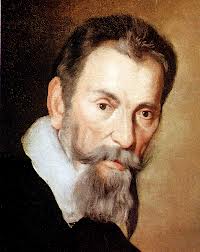 1567. A seminal figure in European music history, he spanned two traditions, the old, Renaissance, and the new, Baroque, and in the process created the new art of opera. We’ve written about him many times, so today we’ll just present one section, Laudate pueri, from his Vespro della Beata Vergine (Vespers for the Blessed Virgin), also known as his 1610 Vespers. Monteverdi composed the Vespers while in Mantua, at the court of the Gonzagas. It was published in Venice and dedicated to Pope Paul V, famous for his friendship and support of Galileo Galilei (but also for nepotism: he made his nephew, Cardinal Scipione Borghese so rich that it allowed Scipione to start what is now known as the Borghese Collection of paintings and sculptures). Back to the music, though: here is Laudate pueri, performed by the British ensemble The Sixteen under the direction of their founder, Harry Christophers.
Carl Goldmark is almost forgotten, but in his day, he was one of the most popular composers in the German-speaking world. His opera Die Königin von Saba (The Queen of Sheba) was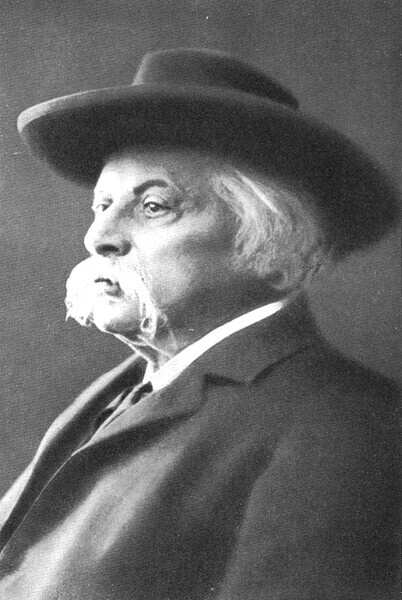 performed continuously from the day it successfully premiered in 1875 in Vienna’s Hofoper, till 1938, when Austria was taken over by the Nazis in the so-called Anschluss. Goldmark was born on May 18th of 1830 in Keszthely, a Hungarian town in the Austro-Hungarian Empire. Goldmark was Jewish (his father was a cantor in the local synagogue); the family came from Galicia, and Goldmark’s first language was Yiddish – he never spoke Hungarian and learned German as a teenager. Goldmark studied the violin in Vienna and later supported himself by playing the instrument in various local orchestras. Around this time, he accepted the German culture as his own, which was the path for many upwardly mobile Jews in Austria and Germany in the second half of the 19th century. Around 1862 he became friends with Johannes Brahms, who had recently moved to Vienna from Hamburg. Goldmark’s first successful composition was a concert overture Sakuntala, based on the Indian epic Mahabharata, which premiered in 1865. Goldmark followed it with another exotic composition, the above-mentioned opera Die Königin von Saba. It was a spectacular success and performances of the opera were mounted internationally. Goldmark became part of the establishment, receiving prizes and honors, and presiding over important musical juries. His 70th and 80th birthdays were celebrated nationally with great pomp. He helped Mahler get his appointment at the Court Opera in 1897; some years later, he did a similar favor to Arnold Schoenberg, who was seeking an appointment to the Imperial Academy of Music and Arts. Goldmark died several months into WWI, grieving the loss of his grandchild who was killed in one of the first actions in Serbia.
Goldmark’s Violin Concerto no. 1 was composed in 1877. It’s a wonderful composition, rarely performed these days. Here is a marvelous recording made by Nathan Milstein in 1957. Harry Blech conducts the Philharmonia Orchestra. We wonder why it’s not being played more often.
Read more...Carl Goldmark - Violin Concerto no. 1
Nathan Milstein (Violin)
The Philharmonia Orchestra (Orchestra)
Harry Blech (Conductor)
Claudio Monteverdi - Laudate pueri, from Vespro Della Beata Vergine
The Sixteen (Ensemble)
Harry Christophers (Conductor)
Listless list, 2023
This Week in Classical Music: May 8, 2023. A Listless List. A whole bunch of composers were born this week, and none of them inspire us. This may change with time: many of our .jpg "Gabriel Fauré, by Sargent") musical attachments ebb and flow. Let’s list the more interesting names: two Frenchmen, born on the same day, May 12th, three years apart: Jules Massenet in 1842 and Gabriel Fauré in 1845. Massenet is famous (or at least known) for his operas; two of them, Manon and Werther, are staged often. His most popular piece, though, is not vocal: it is Meditation, from his opera Thaïs, for the violin and orchestra. Here it is played by Mischa Elman, at his Russian Romantic best. While Massenet was rather conservative, Fauré, was forward-looking and influenced many composers of the early 20th century. Here is Fauré’s Pavane, performed by the Berlin Philharmonic under the baton of Simon Rattle.
musical attachments ebb and flow. Let’s list the more interesting names: two Frenchmen, born on the same day, May 12th, three years apart: Jules Massenet in 1842 and Gabriel Fauré in 1845. Massenet is famous (or at least known) for his operas; two of them, Manon and Werther, are staged often. His most popular piece, though, is not vocal: it is Meditation, from his opera Thaïs, for the violin and orchestra. Here it is played by Mischa Elman, at his Russian Romantic best. While Massenet was rather conservative, Fauré, was forward-looking and influenced many composers of the early 20th century. Here is Fauré’s Pavane, performed by the Berlin Philharmonic under the baton of Simon Rattle.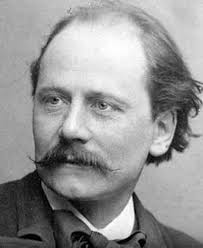
Carl Stamitz, the eldest son of Johann Stamitz, both prominent representatives of the Mannheim School, was baptized on May 8th of 1745. The American composer and pianist, Louis Moreau Gottschalk was born on that day in 1829 in New Orleans. Even if his music is mostly forgotten, his life was fascinating, and we’ll return to him someday. Giovanni Battista Viotti, an Italian violin virtuoso and composer, was born on May 12th of 1755. Viotti composed 29 violin concertos, some of them still in the active repertory, but we didn’t have a single piece of his in our library. We’re correcting the omission with this performance of his Violin concerto no. 22 with the wonderful Belgian-Romanian violinist Lola Bobesco. Kurt Redel conducts the Staatsphilharmonie Rheinland-Pfalz orchestra. Another Italian, Giovanni Paisiello, was born on May 9th of 1740. His most popular opera was Il Barbiere di Siviglia, composed in 1782 with the libretto adapted from Beaumarchais’s play, as was Rossini’s famous masterpiece, written some 36 years later.
Milton Babbitt was one of the most interesting (and difficult) American composers of the 20th century, and we wrote about him here. And speaking of fascinating lives, Arthur Lourié’s certainly was: he was linked, romantically or otherwise, with a good part of the Russian Silver Age artists, from the poet Anna Akhmatova to the painter Sudeikin, to Stravinsky and Vera de Bosset, Stravinsky’s eventual wife. Some of these relationships were rather unconventional; we’ve touched upon them here.
Two conductors were also born this week, Carlo Maria Giulini, on May 9th of 1914, and Otto Klemperer, on May 14th of 1895. Giulini, together with Arturo Toscanini, Victor de Sabata, and Claudio Abbado, was one of the few truly great Italian conductors (we probably should add Giuseppe Sinopoli and Riccardo Muti to the list). During his long career (he died at the age of 91) Giulini was closely associated with the Chicago Symphony Orchestra, London's Philharmonia, the Vienna Philharmonic, and sever other major ensembles. The number of prominent German 20th-century conductors is much larger, and Otto Klemperer was always considered one of the best. We wrote about him recently here. An interesting note: Giulini’s first instrument was the viola, and as a young man, he played in the orchestra of the Accademia di Santa Cecilia in Rome. Among the conductors whose music-making affected him the most were the Germans: Wilhelm Furtwängler, Bruno Walter – and Klemperer.
Read more...Gabriel Fauré - Pavane
Berlin Philharmonic Orchestra (Orchestra)
Simon Rattle (Conductor)
Giovanni Battista Viotti - Violin Concerto No. 22
Lola Bobesco (Violin)
Staatliche Philharmonie Rheinland-Pfalz (Orchestra)
Kurt Redel (Conductor)
Ludwig van Beethoven - The Last Three Piano Sonatas
Maria Perrotta (Piano)
Pfitzner, Alessandro Scarlatti, 2023
This Week in Classical Music: May 1, 2023. Pfitzner, Double Birthday and Alessandro Scarlatti. The German composer Hans Pfitzner was born in, of all places, Moscow, Russia, on 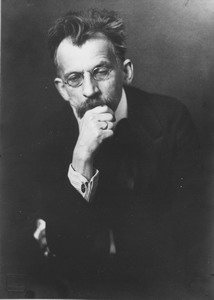 May 5th of 1869. We wanted to write about him not because of his talent but because of the period he lived in, the one preceding the 1933 Nazi takeover and then the Nazi period in Germany and later Austria. We find this time frame of Austro-German music fascinating. Never before were music and politics as intertwined as then and there, and never in modern times were the ethics of the musicians tested to the same degree. Then it occurred to us that just two weeks ago we wrote about Max von Schillings, whose path was somewhat similar to Pfitzner’s. So, we decided to return to Pfitzner at a later date. Pfitzner was a better composer and not as rabid a Nazi supporter as Schillings, so we feel that we can play some of his music. Here are Three Preludes from his most successful opera, “Palestrina” (preludes to Acts I, II, and III). Christian Thielemann conducts the orchestra of the Deutsche Oper Berlin.
May 7th is special: Pyotr Tchaikovsky and Johannes Brahms were both born on this day, Tchaikovsky in 1840 and Brahms seven years earlier, in 1833. This is a rather unfortunate coincidence as both of them deserve separate entries. On the other hand, we’ve written so many entries about these composers, together and separately, that we’ll skip them this time.
These days Alessandro Scarlatti’s son Domenico is much better known than his father, but we think this is a purely technical issue: Alessandro was famous for his operas whereas Domenico – for his small clavier sonatas. It’s much easier to squeeze a three-minute piano piece into a recital or as a filler on a classical music radio station than stage a three-hour opera production. Scarlatti composed 65 operas, most of them in three acts. The exceptions being the famous (or as famous as Alessandro Scarlatti’s opera can get), Il Mitridate Eupatore, and Il trionfo della libertà are in five acts; both composed in 1707. Of all of his operas, probably five have been recorded (his oratorios fared a little bit better; Scarlatti wrote more than 30 of them, and being shorter, they are easier to produce). Alessandro Scarlatti was born on May 2nd of 1660 in Palermo. He spent most of his time in Rome and Naples and is considered “the father” of the Neapolitan opera. Even though opera was his favorite art form, he also wrote some church and orchestral music. We can listen to two examples: here’s his short (just five minutes) Concerto Grosso no. 4, performed by the ensemble Europa Galante under the direction of Fabio Biondi. It was composed around 1715. And here is Kyrie, from his St. Cecilia Mass (1720). The Wren orchestra, the choir of St. John’s College, Cambridge, and the soloists are led by George Guest.
Read more...Alessandro Scarlatti - Kyrie, from Santa Cecilia Mass
The Wren Orchestra (Orchestra)
The Choir of St John’s College, Cambridge (Chorale)
George Guest (Conductor)
Richard Wagner - Prelude to Atc I of Parsifal
Vienna Philharmonic Orchestra (Orchestra)
Georg Solti (Conductor)