
George Frideric Handel - Rodrigo Suite
Arion Orchestre Baroque (Orchestra)
Barthold Kuijken (Conductor)
Young Handel
This Week in Classical Music: February 22, 2021. Young Handel. George Frideric Handel was born on February 23rd of 1685 in Halle. We’ve written about this great composer many times 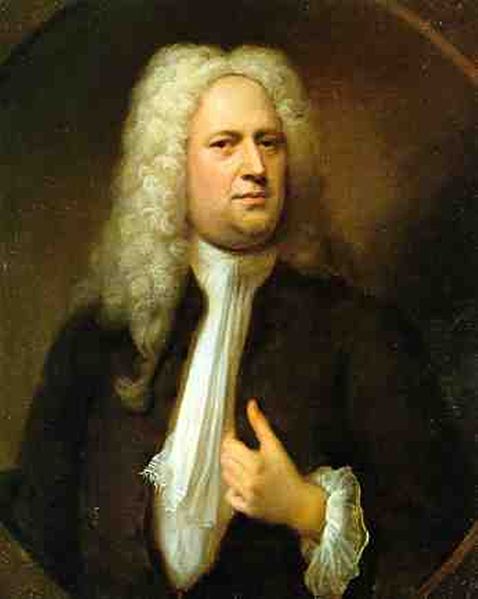 (for example, here and here). We want to come back to his early days in Italy though, as we find the progress of the young Handel quite remarkable even by the standards of major talents. Handel lived in Halle for the first 18 years of his life. From early on it was clear that he was musically gifted; in his teens he played the organ in the main church and composed, but as the only son who lost his father early, he had many responsibilities and couldn’t dedicate himself to music to the extent he wanted. In 1702 Handel visited Berlin, were he probably met with Giovanni Bononcini who was staging operas for the Prussian court. In 1703 Handel moved to Hamburg, hoping for a position at the Oper am Gänsemarkt, then the only municipal opera company in Germany (all other opera theaters were set up by royal courts, of which there were many). Handel was hired as the opera orchestra’s violinist, but later switched to playing the continuo (harpsichord). In 1704 Handel’s first opera, Almira, was staged at the theater and proved to be successful. He composed at least three more operas but the music for them is lost. From the late1690s the Hamburg Opera was dominated by the composer Reinhard Keiser, the author of more than 100 operas. On the one hand, Keiser’s music was influential (Handel quoted him not only in Almira, but in many other operas throughout his life); at the same time, as a junior composer, Handel felt highly constrained.
In 1706 he met the younger brother of Ferdinando de' Medici, duke of Tuscany, who was visiting Hamburg. The prince showed Handel examples of talian music and invited him to the court. Handel declined the invitation but decided to go to Italy on his own. He left Hamburg late in 1706; we don’t know if he visited Florence, but by 1707 he was in Rome. Almost immediately he found several influential patrons, the cardinals Carlo Colonna, Benedetto Pamphili, who became a good friend, and probably also Cardinal Pietro Ottoboni, about whom we wrote an entry several years back. On the commission of Colonna, Handel composed the setting of Dixit Dominus; it was performed in July of that year (here’s the introductory part of it, Le Concert d'Astrée is conducted by Emmanuelle Haïm). Also in 1707, he composed his first Italian opera, Il trionfo del Tempo e del Disinganno, except that it had to be called (and staged as) an oratorio, as the Pope had banned all opera performances in Rome. The libretto was written by Benedetto Pamphili himself. Later that year Handel joined the household of the Marquess Francesco Maria Ruspoli, a member of the Accademia dell'Arcadia and one of the most important secular patrons in Rome. Ruspoli had a castle in Vignanello, about 60 km north of Rome, and Handel was spending part of the time there. For Ruspoli, Handel was writing one cantata a week, plus some miscellaneous music and motets for the church at Vignanello. At the same time, Handel was working on an opera for Ferdinando de’ Medici, as operas were all the rage in Florence. It was produced there in October of 1707 under the title Vincer se stesso è il maggior vittoria, but we know it as Rodrigo. Here’s the Suite from Rodrigo performed by the Arion Orchestre Baroque under the direction of Barthold Kuijken.
We’ve covered, however briefly, the first year of Handel’s short Italian sojourn. We’ll come back with the rest of it soon.
Read more...George Frideric Handel - Dixit Dominus
Le Concert D'Astrée (Ensemble)
Emmanuelle Haïm (Conductor)
Dmitri Kabalevsky - Lyric Piece
Nico De Napoli (Piano)
AbdulWahab - I beyond to you
AbdulWahab (Piano)
Refat Hasan Composer - On Sea Shore
Refat Hasan (Piano)
Refat Hasan Composer - Relax
Refat Hasan (Ensemble)
Ludwig van Beethoven - excerpt from Op. 109 slow movement Andante 0 Gesangvoll, mit innigster Empfindung
Prof. Hao Huang (Piano)
Pianists_February-2021
This Week in Classical Music: February 15, 2021. Pianists. Several pianists of note were born this week and several more just a couple of days earlier. Some of them left us a rich audio record of their art so we can judge their talent for ourselves, but of the ones who were born in the earlier 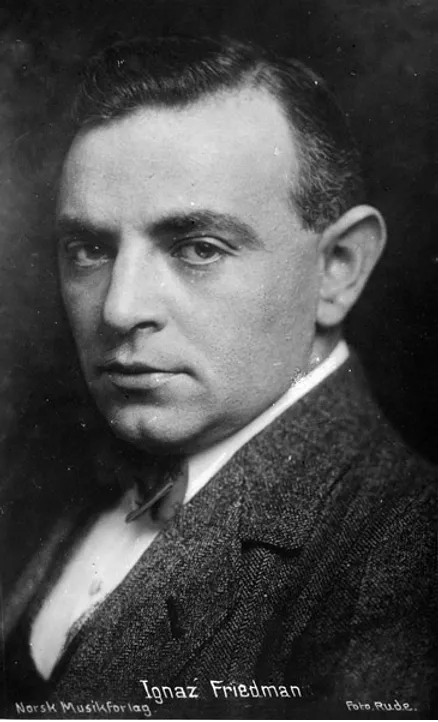 era we know mostly from the effusive descriptions by their contemporaries. Leopold Godowsky and Ignaz Friedman, both Polish Jews, were born on the same day, February 13th, Godowsky in 1870, Friedman in 1882. Godowsky is better remembered these days, partly because of his compositions (especially the piano arrangements), but also because of his pupils, one of whom, Heinrich Neuhaus, continued the legacy through his own numerous pupils, Sviatoslav Richter and Emil Gilels among them. Godowsky’s last acoustic recording was made in 1928, and many of the earlier ones were made on a piano roll, which doesn’t convey the nuances of the performance. Friedman was 12 years younger than Godowsky and could’ve had a much larger recorded legacy as the technology was getting consistently better but, unfortunately, even in his case there are not that many surviving recordings. Friedman was born near Krakow and took his first piano lessons there. He then moved to Leipzig and, in 1901, to Vienna where he studied with Theodor Leschetizky (who also taught Godowsky), eventually serving as his assistant. Friedman played his first public concert in Vienna in 1904; he had a brilliant career in Europe and then in Australia. He gave his last concert in 1943 (Friedman died in Sydney on January 26th of 1948). Vladimir Horowitz used to say that Friedman’s technique was better than his own, but what is most noticeable when one listens to his recordings is the amazingly flexible rhythm and exquisite phrasing, very “romantic” by today’s standards – nobody plays like this these days – but utterly convincing. Here’s Chopin’s Ballade no. 3, recorded sometime around 1940.
Alexander Brailowsky was born February 16th of 1896, 14 years after Friedman. Like Godowsky and Friedman, he was Jewish and also born in the Russian Empire (in Kiev, now the capital of the independent Ukraine). And like Friedman and Godowsky, he studied with Leschetizky in Vienna. At the beginning of the Great War the family moved to Switzerland, where Alexander took lessons with Ferruccio Busoni. Brailowsky was the first pianist ever to perform all of Chopin’s piano compositions. In 1938, during his sensational tour of South America he stayed in Buenos-Aires for two months and gave 19 concerts, never playing the same piece twice. Like Ignaz Friedman, Brailowsky loved to play Chopin, probably the influence of their teacher Leschetizky. Here’s a recording of the Nocturne no. 1 in B-Flat Minor, Op. 9, made in 1957.
Nikita Magaloff, who was born on February 21st of 1912 in St.-Petersburg into a noble Georgian family of Maghalashvilis, came from a very different musical tradition than the pianist we’ve mentioned above, but he, as Friedman and Brailowsky (and to a large degree Godowsky), was also a wonderful Chopinist. Magaloffs emigrated from Russia in 1918 and settled in Paris. Nikita studied at the Paris Conservatory with Isidor Philipp and at the age of 17 won a premier prix. He also studied with Sergei Prokofiev, a family friend. In 1939 he moved to Switzerland and lived there for the rest of his life. While Brailowsky was the first pianist to play all of Chopin’s pieces, Magaloff was the first one to record all of them. He died in Vevey on December 26th of 1992. Here’s Magaloff playing Chopin’s Impromptu no. 3 in G-flat major, Op. 51.
Read more... « first ‹ previous … 107 108 109 110 111 112 113 114 115 … next › last »
P. kellach Waddle - Op.683 An Epiphanytide Tryptch for Organ
Thomas B. Dawkins (Organ)