
Benedetto Marcello - Requiem In The Venetian Manner, Kyrie I and II
Academia de li Musici (Ensemble)
Filippo Maria Bressan (Conductor)
Benedetto Marcello - Psalm 3, O Dio perché
Cantus Cölln (Ensemble)
Konrad Junghänel (Conductor)
Johann Sebastian Bach - Harpsichord Concerto No. 1 in D Minor, BWV 1052: III. Allegro
Gulan (aka Andrei Gulaikin) (Synthesizer)
Stravinsky, 2024
This Week in Classical Music: June 17, 2024. Stravinsky. Is it just us or did the music of Stravinsky lose some of its magic? Not that long ago it seemed that Stravinsky’s place at the very 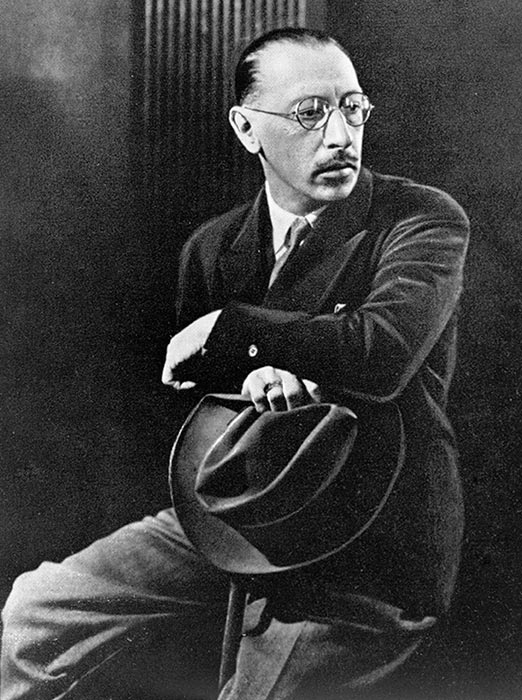 top of the musical Olympus was unshakable – but maybe listeners have had too much of The Rite of Spring and piano transcriptions of Petrushka. That Igor Stravinsky, born on June 17th of 1882 outside of St. Peterburg, was a genius is without a doubt. He had several creative phases: the initial, “Russian” phase, closely linked to Sergei Diaghilev, a great Russian impresario who established himself in Paris. It was during this period and owing to Diaghilev’s commissions that Stravinsky composed his most popular ballets: The Firebird (1910), Petrushka (1911), The Rite of Spring (1913), Les Noces (The Wedding, 1914-17). He made symphonic suites out of The Firebird and The Rite and transcribed parts of Petrushka for the piano; the public knows them better in these incarnations. He also composed two operas, The Nightingale in 1914 and Histoire du soldat in 1918, and, as with the ballets, he then used them to write orchestral pieces, Song of the Nightingale and a chamber suite from the Histoire. This was a remarkably fertile period: his music was unlike anything else ever composed (and therefore, scandalous, which only helped his fame), its harmonies and dissonances, its rhythms, the Russian exoticism – all of it captivated the public. By the end of WWI Stravinsky was acknowledged as one of the greatest living composers. And then, in the early 1920s he completely changed his style, the very nature of his compositions, replacing the wild, in-your-face energy of The Rite of Spring and other Russian-phase compositions with the Apollonian clarity, balance and emotional distance of the ballets Pulcinella, Apollo, and The Fairy's Kiss; the opera Oedipus rex, and several instrumental pieces. Later he wrote three symphonies, Symphony of Psalms (1930), Symphony in C (1940), and Symphony in Three Movements (1945). All three are composed mostly in the “neo-classical” style, though one can hear the younger Stravinsky in all of them. And then he made another turn, this time to the twelve-tone technique of his rival, Schoenberg. That was in the mid-1950s when Stravinsky was already in his 70s. In music, this capacity to reinvent himself is unique but he had a great counterpart in the arts, Pablo Picasso, who also went through many “periods”: Blue, Rose, Cubism, Neoclassical, Surrealist, and so on. For a long time, Picasso was considered the greatest artist of the 20th century, but recently we came across an article that questioned his primacy. Is the same happening to Stravinsky?
Here, from the late neo-classical period, is Stravinsky’s Symphony in Three Movements. In this 1985 live recording, Leonard Bernstein leads the Israel Philharmonic.
Read more...Igor Stravinsky - Symphony in Three Movements
Israel Philharmonic Orchestra (Orchestra)
Leonard Bernstein (Conductor)
Carnegie Hall - String Quartet in Modo Lidico by Tatiana Mikova. Performed by the Lehner Quartet.
07/01/2024 19:00, Carnegie Hall, New York, USA
Czech composer's debut at Carnegie Hall! Czech composer Tatiana Mikova presents her String Concerto Modo Lidico at Carnegie Hall's Weill Recital Hall. The concert will be performed by the Lehner Quartet on July 1, 2024.
Georgy Sviridov - Time, Forward!
Gulan (aka Andrei Gulaikin) (Synthesizer)
On Place of Music in Culture, 2024
This Week in Classical Music: June 10, 2024. On Place of Music in Culture, again. Edvard Grieg and Richard Strauss were born this week, the Norwegian on June 15th of 1843, and the 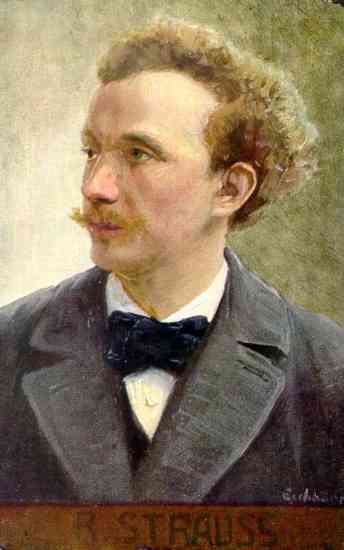 German – on June 11th of 1864, but this is not what we want to write about this week. The pianist Bruce Liu played a recital in Chicago on Sunday a week ago. Mr. Liu is 27, he was born in Paris and raised in Montreal. Three years ago, he won the Chopin Piano Competition and since then his career has taken off. We heard good things about him, and his YouTube videos sounded interesting; we considered going to the concert but then circumstances intervened and we missed it. A couple of days later, interested in learning how Mr. Liu had played, we went online looking for a review. It turned out that not a single Chicago media outlet sent a reviewer to the concert: not the Chicago Tribune, not the Sun-Times, not even Larry Johnson’s Chicago Classical Review. We don’t know if Mr. Lui played well; what we do know is that the audience was very happy with him: he played six encores, all of them listed in the CSO updated program.
 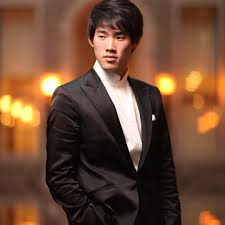 Of course, the number of encores depends not only on the public’s enthusiasm but also on the performer – some prefer not to play any, as, for example, Sviatoslav Richter or Claudio Arrau later in their careers, others, likeEvgeny Kissin, enjoy playing them. Still, six encores at Orchestra Hall is a substantial number, which very likely reflects the audience’s appreciation, whether of the pianist's technique or musicianship, that we don’t know (that the technique is there is certain: listen to this half-minute Etude by Alkan).
And here’s another thing: while looking for a review, we came across one from the Stanford Daily. Musicians often perform on campuses, and it seems that student newspapers are better at covering classical music than the mainstream media (we saw several more of those). The review was enthusiastic if not very professional, but that was a minor problem. What caught our eye was a disclaimer that preceded the review itself. It said, “This article is a review and includes subjective thoughts, opinions and critiques.” Just think about it for a second: the readers, mostly students, were warned (or, in modern parlance, trigger-warned) that the article they’re about to read may include such scary things as “opinion and critique.” It is like the warning TV news programs give their thin-skinned viewer when covering wars, that some unpleasant things may be seen, probably because they don’t trust their audience to know what a war is. These warnings about thoughts, opinions and critiques are a direct consequence of the cultural metamorphosis on our campuses that also produced “safe spaces” and the notion of microaggression, and which, in the last years, spread out to society at large. It will take at least a generation to get rid of this inanity.
If anything, the program Bruce Liu played in Chicago was very imaginative: a sonata by Haydn, Chopin’s sonata no. 2, a piece by Kapustin, several pieces by Rameau, with Prokofiev’s Piano Sonata no 7 concluding the announced part of the program (the encores were by Bach, Chopin, Tchaikovsky and Liszt). Here’s one piece he played during the concert: Rameau’s Gavotte with six doubles from Nouvelles suites de pièces de clavecin. We think it’s very well-played, nuanced and in good taste.
Read more...Jean-Philippe Rameau - Gavotte with six doubles, from Nouvelles suites de pièces de clavecin
Bruce Liu (Piano)
Giacomo Puccini - Si. Mi chiamano Mimi, from La Bohème
Anna Moffo (Soprano)
Rome Opera House Orchestra (Orchestra)
Tullio Serafin (Conductor)