
Holst 150, 2024
This Week in Classical Music: September 16, 2024. Gustav Holst. We must admit that we’re not big fans of Gustav Holst’s music, though we readily acknowledge the talent of this English 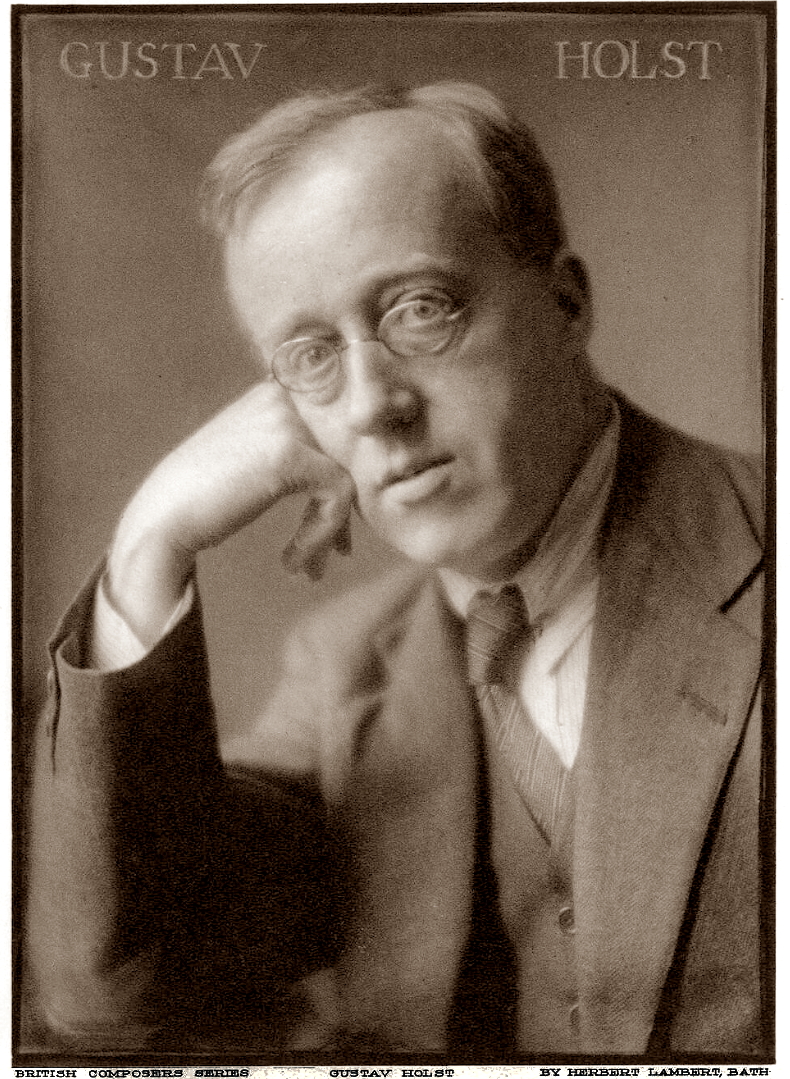 composer. Neither are we greatly enamored with the music of his best friend Ralph Vaughan Williams, or the older and more famous Edgar Elgar, or practically any other British composer of the late 19th - early 20th century. We know they’re all very dear to the English heart, but we find the music composed during the same period in Germany, Austria, France and Russia much more interesting and more to our taste. Nevertheless, September 21st marks the 150th anniversary of Holst’s birth, and obviously, we should recognize this important date. (History plays games with us: just last week we celebrated the 150th anniversary of Arnold Schoenberg, creating an interesting if unintended juxtaposition).
Holst was born in Cheltenham, a spa town in the Cotswolds. His father’s side of the family was of German descent and musical, his mother was English. Interested in music from an early age, Holst studied composition at the Royal College of Music with the prominent composer Charles Villiers Stanford. Till The Planets were first performed in 1918, Holst had to support himself by teaching and playing the trombone in different orchestras; none of his early compositions achieved popular success. That all changed with The Planets. This is an unusual piece, as few seven-movement symphonic works have ever been composed. Holst started working on it in 1913 and completed the suite in 1917. The premier, held on September 29th of 1918, less than six weeks before the end of WWI, was conducted by Adrian Boult. Boult, then 28 years old, lived to the ripe age of 92 and conducted almost till the end. The concert took place in the old Queen’s Hall, then the main performance venue in London (the hall was destroyed by a German bomb in 1941). It was a semi-private affair, as only selected listeners were invited, and the hall was half empty. While the structure and the musical language of the composition were quite unusual, many of the reviews were positive, and even those newspapers that first panned the music changed their minds soon after. Even though several subsequent performances played only four or five movements of the whole work, The Planets’ reputation grew with every concert and solidified soon after. In 1922 Holst himself conducted the first recording of the suite; more than 80 recordings have been made since then.
Here is the first movement of The Planets, Mars, the Bringer of War. Herbert von Karajan conducts the Vienna Philharmonic. And here, with the same performers, is the very contrasting last movement of the suite, Neptune, the Mystic, with a hidden chorus. This recording was issued in 1962.
Read more...Gustav Holst - Neptune, the Mystic, mov. 7 from The Planets
Herbert von Karajan (Conductor)
Gustav Holst - Mars, the Bringer of War, mov. 1 from The Planets
Wienna Philharmonic Orchestra (Orchestra)
Herbert von Karajan (Conductor)
Arnold Schoenberg 150, 2024
This Week in Classical Music: September 9, 2024. Schoenberg 150. Last week we celebrated the 200th anniversary of Bruckner’s birth. This week is no less important: September 13th marks 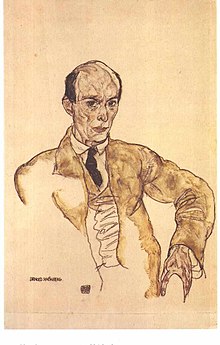 the 150th anniversary of one of the most consequential composers in the history of Western music, Arnold Schoenberg. Schoenberg was born in Leopoldstadt, a heavily Jewish district of Vienna, in 1874. Two years ago we published a series of four entries about him, here, here, here, and here, so we won’t go into the details of his life today. Even though Schoenberg’s music is still played only occasionally, especially pieces from his atonal and twelve-tone phases, it's generally accepted that he was a seminal figure in the history of music, and, given that it’s such an important date, many institutions around the world celebrate his anniversary with festivals and performances. Vienna, his birthplace, is exceptional in this regard, setting up exhibitions, a film festival, and many concerts. On Schoenberg’s birthday, September 13th, and the following day, the Vienna Symphony, three choruses and soloists, all under the direction of Petr Popelka, will perform his Gurre-Lieder, an oratorio in three parts, composed between 1900 and 1903 but finished in 1911 (Gurre-Lieder, together with Verklärte Nacht, is considered the most important of Schoenberg’s pieces from his tonal, late-Romantic period). Germany, where Schoenberg lived for years, mounted more events and performances than any other country, they’re spread among many cities. California, Schoenberg’s home for the last 16 years of his life, also celebrates the event with several concerts. The Chicago Symphony, on the other hand, completely ignored the anniversary. In general, Europe seems to be much more interested in Schoenberg than the US. Even in war-torn Ukraine, they plan to have two Schoenberg concerts, both in Kyiv. New recordings are also being made. Fabio Luisi, the Italian conductor who leads three orchestras at the same time - the Danish National Symphony, the Dallas Symphony and the NHK Symphony in Japan, is embarking on the most ambitious project. He plans to record all of Schoenberg’s symphonic output with the Danish NSO and distribute it on the Deutsche Grammophon label.
We’ll celebrate Schoenberg’s anniversary with two different pieces, his Five Pieces for Orchestra, op. 16, from 1909, and Four Orchestral Songs for soprano and large orchestra, composed between 1913 and 1916. Opus 16 was written while Schoenberg was still working within the tonal idiom, although by then he was already using “extreme chromaticism.” This music is clearly beyond the Romanticism of his earlier works. Here it is, performed by the London Symphony, Robert Craft conducting.
The admittedly more difficult Four Songs are the last ones from Schoenberg’s free atonal period, the one that followed his Romantic beginnings. After that, and for a long period, he wrote music using his own newly developed twelve-tone technique (at the end of his life he would sometimes revert to tonal compositions). The singer in this recording is the mezzo Catherine Wyn-Rogers. Robert Craft is again the conductor, in this case leading the Philharmonia Orchestra.
A note: while we’re celebrating Arnold Schoenberg, we remember that this week is rich in important birthdays, Henry Percell and Girolamo Frescobaldi’s among them, and also Clara Schumann’s and Arvo Pärt’s, who will be 89 on September 11th.
Read more...Arnold Schoenberg - Four Orchestral Songs, Op. 22
Catherine Wyn-Rogers (Mezzo-soprano)
Philharmonia Orchestra (Orchestra)
Robert Craft (Conductor)
Arnold Schoenberg - Five Orchestral Pieces Op. 16
London Symphony Orchestra (Orchestra)
Rober Craft (Conductor)
Bruckner 200, 2024
This Week in Classical Music: September 2, 2024. Bruckner 200. Several composers were born this week, the first and foremost of them – Anton Bruckner. We’re celebrating his 200th 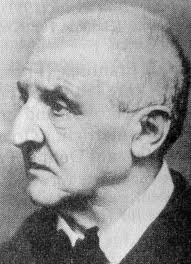 anniversary: Bruckner was born September 4th of 1824 in Ansfelden, a village outside of Linz. We love Bruckner and have written about him on many occasions, him personally (here, for example), as well as his music (here, about one of the several symphonies that we’ve touched upon). We had mentioned Bruckner’s notorious lack of confidence often: he was convinced that professional musicians knew and understood his music better than he did himself. This resulted in Bruckner rewriting major parts of practically all his symphonies over and over, sometimes following innocuous comments. In best cases we’re left with many editions of the same symphony: for example, he revised his Symphony no. 4, one of his most popular symphonies today, five times, and there are numerous editions of each revision, around 10 of them altogether. The Fourth was composed in 1872, the first revision followed one year later while the last one – in 1892, twenty years after the original composition was put to paper. But sometimes, things turned out much worse. Between January and September of 1869, Bruckner composed a symphony. It followed Symphony no. 1, which Bruckner completed in 1866 (as usual, many versions would follow, all the way to 1891), so he called it Symphony no. 2 (in D minor). Then, Otto Dessoff, a minor composer but a noted conductor who then led the Vienna Philharmonic, made a comment, and we’ll quote Georg Tintner, an Austrian conductor, on the consequences. "How an off-hand remark, when directed at a person lacking any self-confidence, can have such catastrophic consequences! Bruckner, who all his life thought that able musicians (especially those in authority) knew better than he did, was devastated when Otto Dessoff (then the conductor of the Vienna Philharmonic) asked him about the first movement: "But where is the main theme?" In the aftermath, Bruckner failed to submit the Symphony for a performance, and some years later, while reviewing his output, wrote "annullirt" ("nullified") on the front page and replaced the number (no. 2) with a symbol "∅" which was later interpreted as zero (0). Since then, the symphony acquired the designation of “Symphony no. 0.” The first performance was made in 1924, 55 years after it was completed, and the first recording – some nine years later, in 1933. There are many wonderful recordings of the symphony, one of them made by Bernard Haitink in 1966 with the Concertgebouw Orchestra. You can listen to it here.
Bruckner had many detractors, Johannes Brahms being the foremost. Antonin Dvořák, Brahms’s follower and beneficiary, was also one of them. Dvořák was born on September 8th of 1841 in Nelahozeves, a village near Prague, then part of the Austrian Empire. His Symphony No.9, "From the New World," ranks highly on many lists of “most popular symphonies.” Clearly, Dvořák was a talented composer, but compared to Bruckner’s they sound somewhat trite, whereas Bruckner’s are fresh and, even now, innovative.
This was a rather special week: Darius Milhaud, Johann Christian Bach, Giacomo Meyerbeer, John Cage, Amy Beach, Isabella Leonarda, and Hernando De Cabezon were all born within these seven days. We’ll come back to some of them at a later date.
Read more...Anton Bruckner - Symphony No. 0 in D minor
Concertgebouw Orchestra (Orchestra)
Bernard Haitink (Conductor)
Anton Bruckner - Symphony No. 0 in D minor, Mov. 3 and 4
Concertgebouw Orchestra (Orchestra)
Bernard Haitink (Conductor)
Johann Sebastian Bach - Allemande in C Minor
Nico De Napoli (Piano)