
Schubert-Liszt - Ständchen -Leise flehen meine Lieder, from Franz Schubert’s Schwanengesang
Sophia Agranovich (Piano)
Franz Liszt - Un Sospiro, from Trois Etudes de concert, S. 144
Sophia Agranovich (Piano)
Giulio Caccini, 2023
This Week in Classical Music: October 2, 2023. Giulio Caccini. During the last couple of months, we’ve published several entries on two subjects: one, the musical transition from the 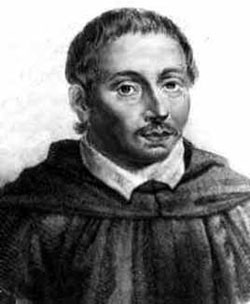 Renaissance to the Baroque and early opera, and another, about some unsavory but talented characters in music. The protagonist of today’s entry falls into both categories. Giulio Caccini was born in Rome on October 8th, 1551. One episode that puts him into the “unsavory” category happened in 1576 when Caccini was in Florence employed by the court of Grand Duke Francesco I de’ Medici. Francesco had a brother, Pietro, who was married to the beautiful Eleonora (Leonora) di Garzia di Toledo. Pietro was known to be gloomy and violent, the marriage was unhappy, and Leonora had several affairs. Caccini, attempting to curry favors from the Duke’s family, spied on Leonora and then denounced her and her lover, Bernardino Antinori, to Pietro. Pietro brought Leonora to Villa Medici at Cafaggiolo, where he strangled her with a dog leash. Leonora was 23. Bernardino Antinori was imprisoned and also killed. The whole story is even more sordid and involves other characters and victims, but though fascinating, it goes even further into Italian history and away from music. One note: if the name of Antinori sounds familiar to wine lovers, it’s not by chance – Bernardino’s family has been making wines since 1385. These days Antinori produce some of the best Chiantis and Super-Tuscans in Italy.
Other episodes are not as gruesome but still attest to Caccini’s character. Two more talented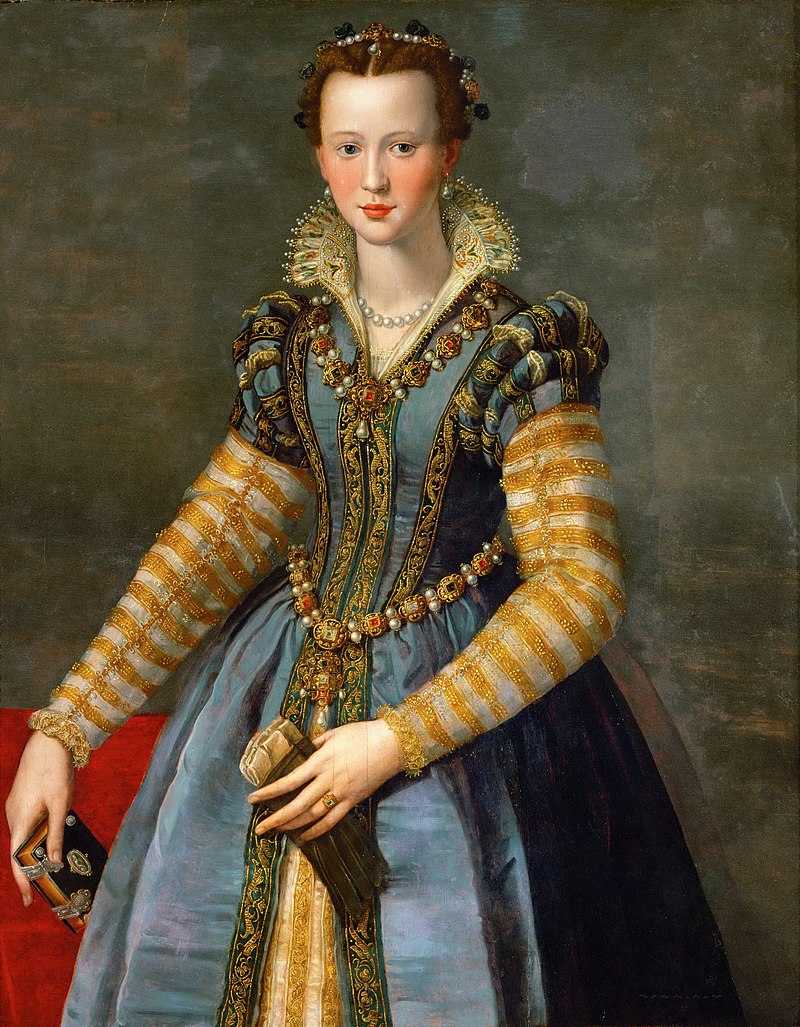 composers worked at the court at the same time, Emilio de' Cavalieri and Jacopo Peri. In 1600, the wedding of Henry IV of France and Maria de' Medici was a very important event. Cavalieri, who oversaw all major festivities of the house of Medici, was expected to direct this one as well. The conniving Caccini had him denied the position, and while Cavalieri did write some of the music, it was Caccini who managed the staging (we described this event here). The disappointed Cavalieri left Florence never to return. As for Peri, the stories are more comical. Upon learning that Peri was writing an opera, Euridice, for the wedding of Maria de' Medici to Henry IV, he rushed to compose his own version using the same libretto and had it published before the first performance of Peri’s work. That wasn’t all; Caccini’s daughter Francesca, a talented singer, was to participate in the performance of Peri’s Euridice. Even though Peri wrote the music for the whole opera, Caccini rewrote the parts performed by Francesca and several other singers under his command, all that just to spite Peri and promote himself. Francesca Caccini, by the way, turned into an excellent composer in her own right. Her opera, La liberazione di Ruggiero dall’isola d’Alcina (The Liberation of Ruggiero from the Island of Alcina) was just staged by the Chicago Haymarket Opera Company (yesterday was the last performance).
Even though Caccini wrote three operas, he’s better remembered for his collection of songs called Le nuove musiche (the New Music), published in 1602. Here are two songs from this collection, Amor, io parte and Alme luci beate, but the whole collection is wonderful. In this 1983 recording, the soprano is Montserrat Figueras, the wife of Jordi Savall, who accompanies her on the Viola da Gamba (Figueras died in 2011). Hopkinson Smith is playing the lute.
Read more...Giulio Caccini - Amor, io parte
Montserrat Figueras (Soprano)
Jordi Savall (Viola da gamba)
Hopkinson Smith (Lute)
Giulio Caccini - Alme luci beate
Montserrat Figueras (Soprano)
Jordi Savall (Viola da gamba)
Hopkinson Smith (Lute)
Florent Schmitt, 2023
This Week in Classical Music: September 25, 2023. Florent Schmitt. We have to admit that we’re fascinated with the “bad boys” of music. They are invariably “boys,” as there are no “bad 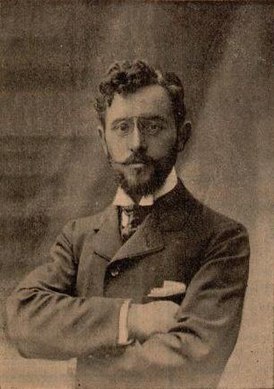 girls” in music historiography that we’re aware of. As for the male composers, there are plenty, Richard Wagner being the quintessential one. In the last couple of years, we’ve written about several of them, mostly the Germans in the 20th century, even though they are not the only ones: there were plenty of baddies in the Soviet bloc and, in a very different way, several Italians of the Renaissance. This week it’s Florent Schmitt’s turn, a French composer infamous for shouting “Vive Hitler!” during a concert. (Dmitri Shostakovich was also born this week, and, as talented as he was, he was no angel either, but we’ll return to Shostakovich another time). Schmitt was born on September 28th of 1870 in the town of Meurthe-et-Moselle, Lorraine, the area that was passing from France to Germany and back for centuries – thus the German name. At 17, he entered the conservatory in nearby Nancy, and two years later moved to Paris where he studied composition with Gabriel Fauré and Jules Massenet. While in Paris, Schmitt became friends with Frederick Delius, the English composer of German descent who was then living in Paris. In the 1890s he befriended Ravel and met Debussy.
Schmitt tried to get the prestigious Prix de Rome five times, submitting five different compositions every year from 1896 to 1900, when he finally won it with the cantata Sémiramis. He spent three years in Rome and then traveled extensively, visiting Russia and North Africa, among other places. One of his most popular pieces composed during the period after Rome is the Piano Quintet op. 51 (1902-1908). Schmitt dedicated it to Fauré. Here’s the final movement, Animé, performed by the Stanislas Quartet with Christian Ivaldi at the piano. The ballet La tragédie de Salomé was composed during the same period, in 1907. Igor Stravinsky was taken by it; in Grove’s quote, he wrote to Schmitt: “I am only playing French music – yours, Debussy, Ravel’. And later, “I confess that [Salomé] has given me greater joy than any work I have heard in a long time.” In 1910 Schmitt created a concert version of the ballet. Here’s the second part of it (the New Philharmonia Orchestra is conducted by Antonio de Almeida). It’s not surprising that Stravinsky liked it, as it clearly presages parts of Rite of Spring. Another important piece, Psalm XLVII, was written in 1906.
During WWI Schmitt wrote music for military bands but returned to regular composing once the war was over. He also worked as a music critic for the newspaper Le Temps. Schmitt was a nationalist with pronounced sympathies toward the Nazi regime. The episode we referred to at the beginning of this entry happened in November of 1933. During a concert of the music of Kurt Weill, a Jewish composer who had beenrecently forced into exile by the Nazis, he stood up and shouted “Vive Hitler!” According to a witness, he added: “We already have enough bad musicians to have to welcome German Jews.” That makes him not only a Nazi sympathizer but also an antisemite. During the German occupation of France, Schmitt collaborated with the Vichy government and was a member of the Music section of the France-Germany Committee. He visited Germany and in December of 1941 went to Vienna to commemorate the 150th anniversary of Mozart’s death. After the liberation, Schmitt was investigated as a collaborator, but these proceedings were later dropped, although a year-long ban was imposed on performing and publishing his music. Soon after everything was forgotten and in 1952, just seven years after the end of the war, Schmitt was made the Commander of the Legion of Honor. In 1996, the controversial past of this "one of the most fascinating of France's lesser-known classical composers," as he’s often described, came into prominence again, and his name was removed from a school and a concert hall.
Read more...Florent Schmitt - La Tragédie de Salomé, Op. 50
New Philharmonia Orchestra (Orchestra)
Antonio de Almeida (Conductor)
Florent Schmitt - Piano Quintet, Op. 51
Christian Ivaldi (Piano)
Stanislas Quartet (Quartet)
Florent Schmitt - La Tragédie de Salomé, Op. 50, part 2
New Philharmonia Orchestra (Orchestra)
Antonio de Almeida (Conductor)
Franz Liszt - CD Album trailer
Sophia Agranovich (Piano)