Welcome to our free classical music site

Do you write about classical music? Are you a blogger? Want to team up with Classical Connect? Send us a message, let's talk!
Do you write about classical music? Are you a blogger? Want to team up with Classical Connect? Send us a message, let's talk!




October 14, 2019. Karl Richter. A noted German composer Alexander von Zemlinsky was born on October 14th of 1871. Here’s our entry from six years ago. We think that the brief aside at the end of it, about the painter who created Zemlinky’s portrait, is quite fascinating and characteristic of the pre-Great War Viennese society. Luca Marenzio, the Italian composer of the late Renaissance active in Rome and Ferrara, was born on October 18th of 1553. Here’s a madrigal Solo et pensoso i più deserti campi, a setting of Petrarch’s poem, by Marenzio. It’s performed by the ensemble La Venexiana, Claudio Cavina conducting. And here is our previous entry on this wonderful composer. Also, the great Soviet pianist Emil Gilels was born on October 19th of 1916. Here is his 1972 recordings of Beethoven’s Piano Sonata No. 21 in C major, Op. 53, Waldstein. Read more about Gilels here.
October 7, 2019. Verdi and Pavarotti. Giuseppe Verdi was born this week (on October 10th of 1813) and so was Luciano Pavarotti, a great interpreter of his music. We’ve written about Verdi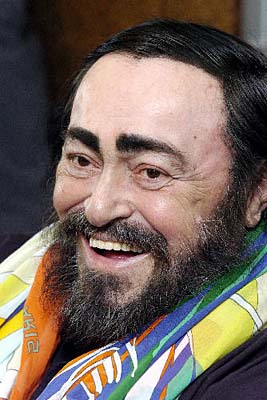 before (for example, here and here) but never about Pavarotti. Luciano Pavarotti was born on October 12th of 1935 in Modena, Italy into a poor family: his father, Fernando, was a baker and his mother a cigar factory worker. Fernando was an amateur tenor (and, according to Luciano, a good one). From an early age Luciano was listening to his father’s recordings of the great Italian tenors: Beniamino Gigli, Tito Schipa, Enrico Caruso, and later those of his hero, Giuseppe Di Stefano. Luciano studied singing in Modena, where one of his teachers, Ettore Campogalliani, also taught his childhood friend, Mirella Freni (Campogalliani also worked with Renata Tebaldi, Renata Scotto, Ruggero Raimondi and Carlo Bergonzi). Rumor has it that Pavarotti never learned to read music. Pavarotti made his debut in 1961 in Reggio Emilia, singing the role of Rodolfo in La bohème. In the next two years he sung in Yugoslavia, Vienna, Moscow and London. While well-received, he wasn’t acclaimed as a future superstar. His break came when Joan Sutherland asked him to join her on an Australian tour, the main reason being that he was tall enough to stand next to her (she was 6’2’’). The grateful Pavarotti later said that he learned the breathing technique from Sutherland during that tour. Pavarotti made his La Scala debut in 1965 in La bohème; Mirella Freni sung the role of Mimi. In 1966 he sung Tonio in Donizetti's La fille du regiment at the Covent Garden, that was when music critics started calling him "King of the High Cs." In 1967 he made his Metropolitan opera debut, again as Rodolfo against’ Freni’s Mimi. With Joan Sutherland he sung on stage and made numerous recordings; some of these recording became legendary. By the early 1980s Pavarotti’s fame hit its zenith. He sung at the Metropolitan (altogether, he performed in 357 Met opera productions) and at all the major opera houses. (He was banned from the Lyric Opera of Chicago, though, for cancelling 26 of his planned 41 appearances). With Placido Domingo and Jose Carreras he created the “Three Tenors” act which became immensely popular, with the public usually not very interested in opera buying millions of records. Pavarotti maintained his voice for a very long time, though not always on the same level. His last performance at the Met was in March of 2004, when he was 68; he sung the role of Mario Cavaradossi in Puccini’s Tosca and received a standing ovation. In July of 2006 Pavarotti was diagnosed with pancreatic cancer. He died in Modena on September 6th of 2007.
Pavarotti, a lyrical tenor, had a bright and open voice of exceptional beauty which floated, seemingly effortlessly, above a full orchestra. In his New York Times obituary, the chief music critic Bernard Holland wrote: “… he possessed a sound remarkable for its ability to penetrate large spaces easily. Yet he was able to encase that powerful sound in elegant, brilliant colors. His recordings of the Donizetti repertory are still models of natural grace and pristine sound. The clear Italian diction and his understanding of the emotional power of words in music were exemplary.” Pavarotti was especially good in the bel canto repertory and in the Puccini operas, but several of his Verdi roles were outstanding. Here he is in the 1983 Metropolitan production of Verdi’s Ernani. James Levine conducts the Metropolitan Opera orchestra and chorus.Permalink
September 30, 2019. Horowitz and Oistrakh. Two supremely gifted musicians with very similar beginnings but vastly different career paths were born this week, the pianist Vladimir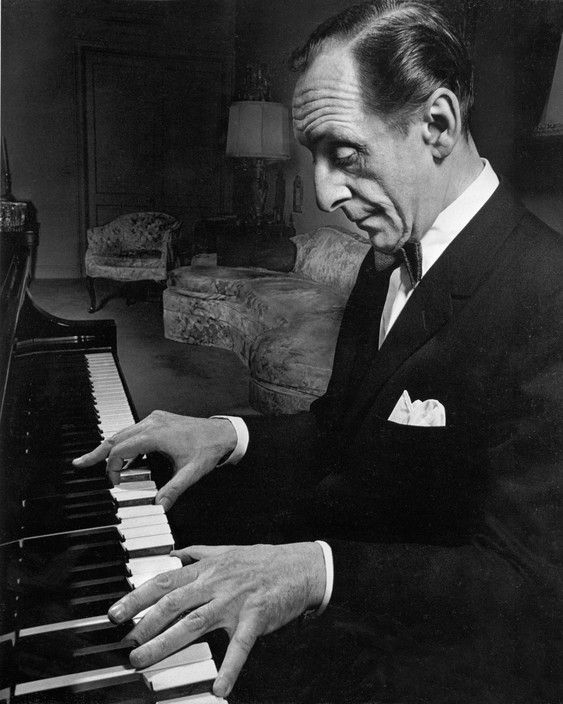 Horowitz and the violinist David Oistrakh. Both Jewish, they were born in Ukraine, then a part of the Russian Empire: Horowitz in Kiev, on October 1st of 1903, Oistrakh in Odessa, on September 30th of 1908. Rampant anti-Semitism notwithstanding, both were born into rather well-to-do families: Horowitz’s father was an electrical engineer, while Oistrakh’s – a merchant of the “second guild,” the reason both families were allowed to live in large cities outside of the Pale of Settlement. Horowitz’s first pianos teacher was his mother, a pianist; he then attended the Kiev Conservatory where one of his professors was Felix Blumenfled, a brilliant pianist and teacher (Maria Yudina was one of his students). Oistrakh’s talents were also obvious from a very early age; he became a pupil of the famous Pyotr Stolyarsky, the founder of the Odessa school of violin playing (among Stolyarsky’s students were Nathan Milstein, Boris “Busya” Goldstein, Elizabeth Gilels and
 other future stars; Milstein, Oistrakh’s good friend, was a link to Horowitz, as just several years later the two of them extensively toured the country together). Oistrakh entered the Odessa Conservatory in 1923, graduating in 1926, at the age of 18. By the mid-1920s both Horowitz and Oistrakh were already famous. Horowitz played more than 150 different pieces during his “Leningrad series” in November 1924 – January 1925; the breadth of the repertoire and the quality of his playing were “stunning” – that’s how the Culture minister, Lunacharsky, characterized the concerts in one of his anonymous reviews. The younger Oistrakh was also playing widely, but mostly in Ukraine. The mid-20s is when their careers took very different turns. In 1925, Horowitz received permission to go to Germany, ostensibly to study; he stayed in the West and returned to the Soviet Union only 60 years later, on a belated but triumphal tour. For several years he performed all over Europe, with enormous success (in 1926, during his Paris Opera concert, the gendarmes were called in to pacify the overexcited crowd which started smashing the seats). Horowitz’s calling card was Tchaikovsky’s First Piano concerto. That was the piece he played during his debut concert with the New York Philharmonic under the direction of Thomas Beecham. Here’s what happened during that concert: “Horowitz broke from Beecham’s stately tempo and charged to the finale several measures before the orchestra. The result was, at once, vulgar and exhilarating, and Beecham fumed at the podium as the audience shouted their appreciation for Horowitz. Critics, too, overlooked his questionable taste and bestowed wild praise on his spellbinding technique” (from encyclopedia.com). In 1933 Horowitz married Arturo Toscanini’s daughter Wanda; they settled in the US in 1939. Horowitz’s phenomenal career continued but with interruptions: a neurotic, he did not play in public between 1936-38, 1953-65 and 1969-74. Horowitz is remembered mostly for his superhuman technique, but we shouldn’t forget his singing sound, the unique color he could produce in any piece, no matter how technically challenging. Here’s the 1930 recording of Liszt’s Etude no. 2in E-flat Major s 14/2 (after Paganini’s Caprice no. 17).
David Oistrakh’s career was indeed very different. In 1927 he moved to Moscow; in 1935 he won the 2nd All-Soviet Performer’s competition, that same year he received the 2nd prize at the Wieniawski competition (after Ginette Neveu) and two years later won the Ysaÿe International competition. He was acknowledged as the no. 1 Soviet violinist, a very special position in the country were arts were state-sponsored and politicized. Oistrakh was allowed to tour the West (he went to the US in 1955 and performed to great success) and was given numerous awards. Oistrakh’s technique was impeccable, the sound – powerful, and while he may not have been the warmest player, his sense of style was impeccable. Here’s David Oistrakh performing live in 1954: La Campanella from Paganini’s Violin Concerto.Permalink
September 23, 2019. Rameau and more. We have a large group of celebrants this week, and we’ll try to address all of them, even if only cursorily. Jean-Philippe Rameau is the oldest of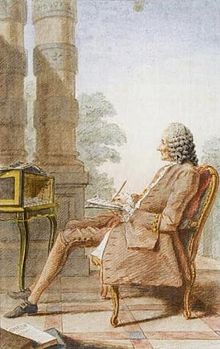 them, he was born on September 25th of 1683 in Dijon. If Jean-Baptiste Lully created the grand French opera, it was Rameau, half a century later, who perfected it. One of many great examples of his art is Castor and Pollux, his tragédie en musique, musical tragedy as it was called at the time, similar to the Italian opera seria. Castor and Pollux was Rameau’s third opera (he started writing them only at age of 50 – before that he wrote mostly music for the harpsichord, much of it of the highest quality, and some choral music). Castor was premiered on October 24th of 1737 by the Académie Royale de Musique (the Royal Opera, founded in 1669 on the orders of Louis XIV and lead by Lully) at its theatre in the Palais-Royal (in our time the Opera performs at the Opéra Bastille and the Palais Garnier). Here’s Agnès Mellon in the aria Tristes Apprêts, with the ensemble Les Arts Florissants under the direction of William Christie.
Two composers, who worked under the Communist regimes of Eastern Europe, were born this week: Dmitry Shostakovich in St.-Petersburg, Russia, on September 25th of 1906, and Andrzej Panufnik, on September 24th of 1914, in Warsaw. The very talented Shostakovich became the national Soviet composer, even though during his long composing career he was threatened many times, and his music was occasionally banned; Panufnik, on the other hand, defected from Poland to the UK (you can read more about him here).
We’ve never written about the Armenian composer Komitas, the founder of the modern national school of music, who was born on September 26th of 1869 in Kütahya in Anatolia, Turkey, where many Armenians lived. Orphaned at 14, he was sent to a seminary in Etchmiadzin, the religious center of Armenia. It was during his years in Etchmiadzin that his love for music, especially Armenian folk music, became apparent. He started collecting local songs, as Bartók would do in Hungary some years later. In 1895 Komitas moved to Tbilisi (then Tiflis), the Georgian capital with a large Armenian community, and a year later – to Berlin where he studied at the prestigious Frederick William (now Humboldt) University. In 1899 he returned to Etchmiadzin and continued collected and publishing folk songs, eventually gathering 3000 pieces of music. In 1910 he moved to Constantinople, where he organized a choir; he toured widely with it, visiting France where his music was admired by Debussy, Saint-Saëns and Gabriel Fauré. In 1915, during the early days of the Armenian Genocide, he was deported to northern Anatolia. The hardships of exile deeply affected Komitas, and he returned to Constantinople a broken man. He was hospitalized and later moved to a psychiatric clinic in France, where lived for almost 20 years, never recovering. He died on October 22nd of 1935; a year later his remains were moved to Yerevan’s Pantheon of Armenian cultural figures. Here’s Komitas’s song “Krunk” (The Crane), transcribed by Georgy Saradjian and performed by Evgeny Kissin in 2015 during the series “With you Armenia,” dedicated to the 100th anniversary of the Armenian Genocide.
George Gershwin was also born this week, on September 26th of 1898. And then there is a whole group of absolutely brilliant performers, which we’ll list now but will get back to at a later date: pianists Glenn Gould and Alfred Cortot, the violinist Jacques Thibaud, the conductor Charles Munch and the tenor Fritz Wunderlich.Permalink
September 16, 2019. Walter. We just missed the birthday of Bruno Walter, one of the greatest conductors of the 20th century. Walter lived a long life: in his youth, he assisted Gustav Mahler,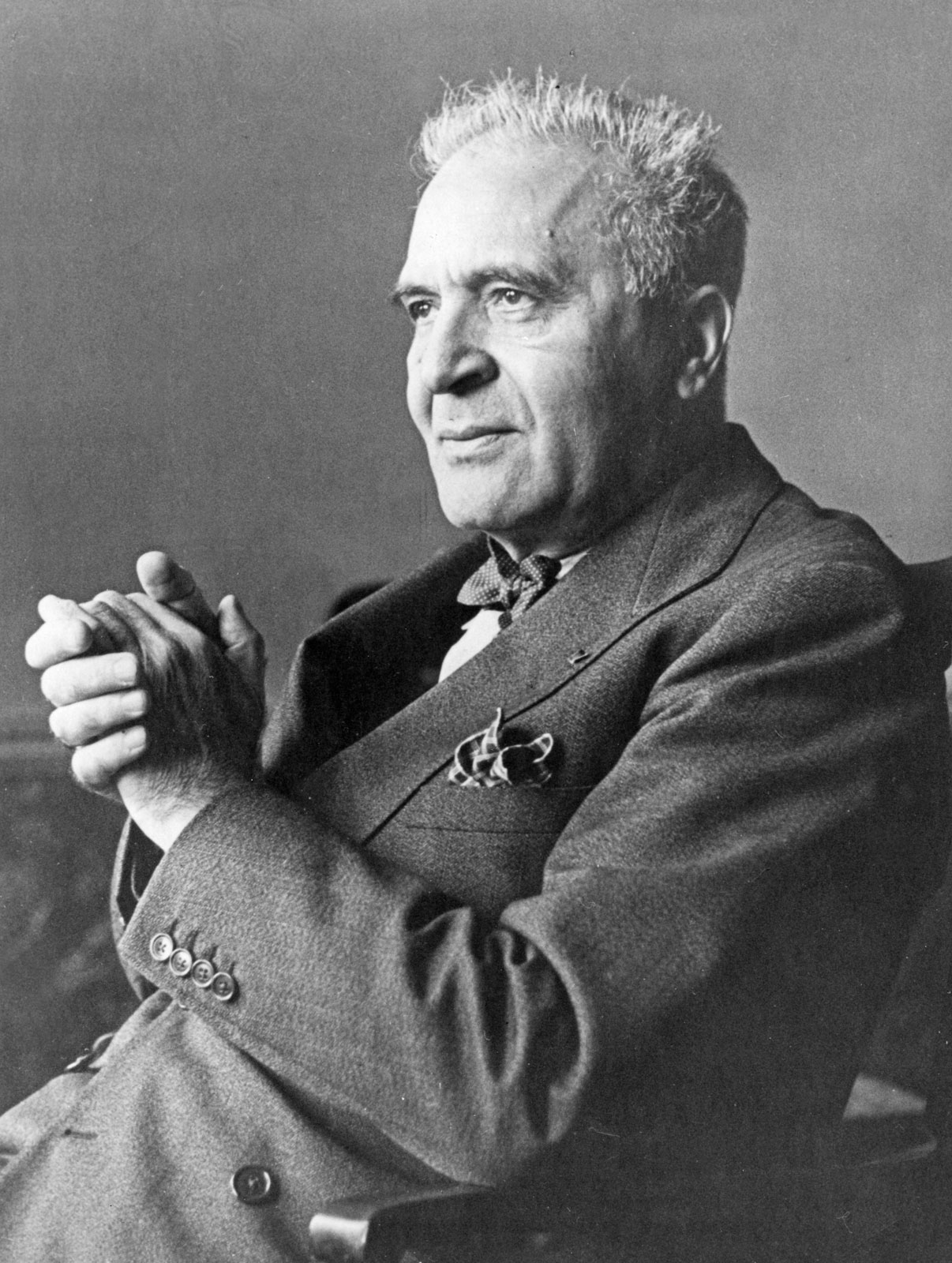 whose work he later helped to establish as the standard orchestral repertory; his last live concert was with Van Cliburn. Few people have influenced the world of music more than him. Walter was born Bruno Schlesinger in Berlin on September 15th of 1876 into a middle-class Jewish family. He initially studied the piano, but, after hearing Hans von Bülow lead an orchestra, decided to switch to conducting. From 1894 to 1896 he worked in Hamburg, assisting Mahler, who was then the chief conductor at the Hamburg State Opera. Mahler’s influence on Walter was enormous, but the composer also valued the talent of his assistant and in 1896 helped him to find a conducting position at the opera theater in Breslau, Silesia (now Wrocław, Poland). The theater director requested that the young conductor changes his name (Schlesinger means “Silesian” in German); eventually, the name Walter was selected. In 1901, after working in several cities, Walter accepted Mahler’s invitation to come to Vienna, were Mahler held the position of the Director of the Hofoper. Walter stayed in Vienna till 1912, two years past Mahler’s death. He gave the premieres of Mahler’s Das Lied von der Erde (in 1911) and Ninth Symphony (in 1912). From 1913 till 1922 Walter lived in Munich, were he was appointed the General Music Director. He conducted a lot of Wagner (Bayreuth was suspended during that time) and, in addition to the standard classical repertoire, some contemporary music. During that time, he toured Europe, guest-conducted the Berlin Philharmonic, and made his New York debut. He also conducted at the Salzburg Festival and was appointed the Music Director of Städtische Oper (now, Deutsche Oper) Berlin. His work in Paris and London opera theaters was very well received. From 1929 to 1933 Walter was the conductor of the Gewandhaus Orchestra, Leipzig but he had to resign when the Nazis came to power and returned to Austria. He made a number of excellent recordings with the Vienna Philharmonic (of Mahler and Wagner in particular) and for two years (1936 – 1938) was the music director of the State Opera, the position Mahler held in the 1900s. Walter left Austria after the Anschluss and moved to the United Stated in 1939.
He was already 63 when he arrived in the US. He moved to Beverly Hills, CA, where many German exiles had settled, Schoenber, Klemperer and Thomas Mann among them. He was invited by many major American orchestras, conducting the New York Philharmonic (he was the music director, or “advisor,” as he called it, in 1947-49; he made a number of memorable recordings there), the Chicago Symphony, LA Philharmonic and the Philadelphia Orchestra. In 1941 he made his debut with the Metropolitan Opera and conducted there, occasionally, till 1959. He returned to Europe many times, and made a number of recordings, for example, the excellent Das Lied von der Erde with Kathleen Ferrier and Julius Patzak and the Vienna Philharmonic orchestra. Bruno Walter died in his home in Beverly Hills on February 17th of 1962. Here is a section from one of the last recordings Walter made: Der Abschied (The Farewell), the 6th movement of Das Lied von der Erde. Mildred Miller is the mezzo-soprano, and Ernst Haefliger is the tenor. Bruno Walter conducts the New York Philharmonic; the recording was made in 1960 when Walter was 84. Permalink
September 9, 2019. Rome, by all means, Rome. Again, we’ll miss a week of great anniversaries. Henry Purcell was born 360 years ago; also this week his compatriot, William Boyce, was born. It’s also Arnold Schoenberg’s 145th birthday. The great Italian composer Girolamo Frescobaldi, originally from Ferrara but very successful in Rome (he was appointed the organist of the St. Peter’s basilica) was also born this week. And so were Arvo Pärt and the pianist great Maria Yudina.