
Isaac Stern 100
This Week in Classical Music: July 20, 2020. Stern 100. Tomorrow is the 100th anniversary of Isaac Stern, one of the greatest violinists and cultural figures of the 20th century. Stern was born 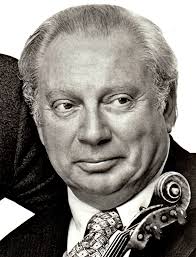 on July 21st of 1920 in the small town of Kremenets which was then in Poland but is now part of the Ukraine. His family was Jewish, many Jews were leaving the pogrom-ridden lands, and so did the Stern family, just one year after Isaac’s birth. They moved to San Francisco; when Isaac was just eight years old, and he was enrolled in the SF Conservatory. He made his recital début in 1935 and a year later he performed Saint-Saëns’s Violin Concerto no. 3 with the San Francisco Symphony under the direction of Pierre Monteux. Stern made his New York debut in 1937, then played there again, to great acclaim, in 1939, establishing himself as one of the top young violinists. He was the first American violinist to tour the Soviet Union in 1956, in the midst of the cold war. In 1961 Stern created a trio with the pianist Eugene Istomin and the cellist Leonard Rose; they stayed together for the next 23 years, performing widely in the US and Europe, and making many highly acclaimed recordings. Stern also organized a piano quartet with the pianist Emmanuel Ax, the violinist Jaime Laredo and the cellist Yo-Yo Ma. Stern had a very broad repertoire, playing all major violin concertos, all trios of Beethoven and Brahms, and major sonatas. A big supporter of contemporary music, Stern gave first performances of concertos by William Schuman, Krzysztof Penderecki, and Henri Dutilleux, among others.
In 1960 the then owner of Carnegie Hall, a developer named Robert Simon, attempted to sell the building to the New York Philharmonic. The orchestra, which was about to move to the Lincoln Center, decline (one of the reasons being the consideration – in retrospect quite absurd – that New York cannot support two major concert halls). Simon then decided to demolish Carnegie Hall and build an office tower in its place. Isaac Stern organized a group to save it. Under pressure from the group, New York City bought the building from Simon. Carnegie Hall Corporation was established to run the hall and Stern became its president; he stayed in that capacity for the rest of his life. It’s hard to imagine today how close Carnegie Hall, one of the greatest halls acoustically and historically, came to being demolished. In 1964 Stern was instrumental in establishing the National Endowment for the Arts.
Here’s Brahms’s Piano Trio no 1, performed by Isaac Stern, Eugene Istomin and Leonard Rose. This recording was made in 1966.
Read more...Mahler and the Music Scene, 2020
This Week in Classical Music: July 13, 2020. On Mahler and the Music Scene. Last week we celebrated Gustav Mahler’s 160th anniversary. WFMT, the premier classical music station based in Chicago, also celebrated the event: they played 10 minutes of the Finale of the Symphony no.  4, when Carl Grapentine, their former morning host who now presents “Carl’s Almanac,” short musical introductions, spoke about Mahler for a couple of minutes. Then, at the end of the day, WFMT played "Adagietto," the fourth movement of Symphony no. 5, which, after so much use and misuse turned trite and reminds one more of Luchino Visconti’s film “Death in Venice” rather than Mahler’s symphony. And this is how the same WFMT celebrated Mahler’s 150th anniversary ten years ago: they played all of his symphonies plus Das Lied von der Erde and several song cycles. They played them without interruption, from beginning to end. This was a heroic undertaking: WFMT is a commercial station and they depend on advertising. There is little opportunity to advertise when you run an hour and 40 minutes of Mahler’s Symphony no. 3 straight from the beginning to the end. And still they did it and it was wonderful. Times have changed… But what actually did change? Did music lovers decide that they prefer lighter pieces, and stations like WFMT got the message and adjusted their programming accordingly? Or have listeners found other outlets, like Pandora, Spotify or other Internet streaming services? That would put pressure on commercial radio station, which would try to boost sagging advertising revenues by playing shorter (and often lighter) pieces to squeeze in more ads. We don’t know for sure, maybe services like Nielsen could tell us. We suspect that people still like Mahler. If you go to YouTube, yet another competitor of radio stations, and search for Mahler’s Symphony no. 3, you’ll find that the video recording made in 1973 of Leonard Bernstein conducting the Vienna Philharmonic with Christa Ludwig was watched more than 1.6 million times. It’s likely that not everybody listened to the entire symphony to the end (even though the finale is sublime), but 1.6 million is an amazing number. And that’s just one recording. Cladio Abbado with the Lucerne Festival Orchestra garnered 240,000 views. Semyon Bychkov with WDR Symphony Orchestra Cologne got another 140,000 views. There are many more recordings of just this one very complex symphony. The easier Mahlerian music, such as his Symphony no. 1, got 2.6 million views (that again from Bernstein and the Vienna Philharmonic). The record holder is probably Gergiev with the so-called Orchestra for Piece, founded in 1995 by Sir Georg Solti: their recording of Mahler’s Symphony no. 5 was watched by four million viewers. So it seems there is no shortage of classical music lovers and outlets to satisfy them. The competition is fearsome and the pressure on classical music radio stations is fierce. We hope they survive, but not by turning away from Mahler.
Pedram Babaiee - 2 Duets for 2 Violins: no.27 in Bb major
Tina Jamegarmi (Violin)
Gustav Mahler 160
This Week in Classical Music: July 6, 2020. Mahler at 160. Gustav Mahler, one of the greatest composers in the history of music (Grove Dictionary is more circumspect, calling him 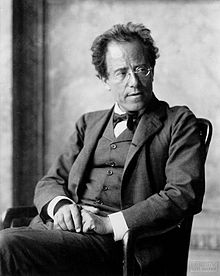 “one of the most important figures of European art music in the 20th century,” but we think he was much more than that) was born on July 7th of 1860 in a small town of Kaliště in Moravia (then Kalischt, Austria-Hungary). We’ve been tracing Mahler’s life by his symphonies, the last one, two years ago, being his Symphony no. 6, written in 1903 – 1904. The Seventh followed soon after: Mahler started working on the symphony in 1904 and completed it a year later; he conducted the premiere in Prague in 1908, the work wasn’t well received. By 1904 Mahler’s routine was well established: he would spend music seasons conducting and producing operas at the Hofoper in Vienna and conducting subscription symphonic concerts, and then compose during several summer weeks at his “composing hut” at Maiernigg on lake Wörthersee, near the resort town of Maria Wörth in Carinthia. The summer of 1904 Mahler spent most of the time struggling to complete the Sixth symphony; as for the next one, he only sketched out two Nachtmusik movements (they would become movements two and four once the symphony was completed). The following year, 1905, he was again in trouble. We quote here Mahler’s letter to his wife Alma from an article by the noted Mahler scholar Henry-Louis de La Grange: “I plagued myself for two weeks until I sank into gloom, as you well remember, then I tore off to the Dolomites. There I was led the same dance, and at last gave it up and returned home, convinced that the whole summer was lost. You were not at Krumpendorf [a town on the opposite side of Wörthersee from Maiernigg]to meet me, because I had not let you know the time of my arrival. I got into the boat to be rowed across. At the first stroke of the oars the theme (or rather the rhythm and character) of the introduction to the first movement came into my head—and in four weeks the first, third and fifth movements were done.” This is quite remarkable, as the first movement lasts about 21 minutes, the third – about 10 and the fifth – about 18: Mahler wrote about 50 minutes of very complex symphonic music in just four weeks.
The years 1904 – 1905 were good to Mahler. He was acknowledged as a great opera conductor, and his symphonic programs with the Philharmonic were popular. Some of his compositions even had critical and popular success (Symphony no. 7 would not go on to be one of them). He lived very comfortably, was happily married, and his second daughter, Anna, was born in 1904. He had many friends and admirers among musicians and developed a special relationship with the Concertgebouw Orchestra and its conductor Willem Mengelberg. Just three years later Mahler would have to leave Hofoper, hounded by antisemitic music critics; in 1907 his first daughter, Maria, would die of scarlet fever and his marriage to Alma would be on the rocks.
Symphony no. 7 consists of five movements, which you could listen to separately Langsam, Allegro, Nachtmusik I, Scherzo, Nachtmusik II, and Rondo-Finale, or to the whole symphony here. Leonard Bernstein conducts the New York Philharmonic in this 1985 recording.
Read more...Gustav Mahler - Symphony no. 7
New York Philharmonic Orchestra (Orchestra)
Leonard Bernstein (Conductor)
Gustav Mahler - Symphony no. 7, mov. 5, Rondo-Finale
New York Philharmonic Orchestra (Orchestra)
Leonard Bernstein (Conductor)
Gustav Mahler - Symphony no. 7, mov. 4, Nachtmusik II
New York Philharmonic Orchestra (Orchestra)
Leonard Bernstein (Conductor)
Gustav Mahler - Symphony no. 7, mov. 3, Scherzo
New York Philharmonic Orchestra (Orchestra)
Leonard Bernstein (Conductor)
Gustav Mahler - Symphony no. 7, mov. 2, Nachtmusik I
New York Philharmonic Orchestra (Orchestra)
Leonard Bernstein (Conductor)
Johannes Brahms - Piano Trio No. 1 in B Major, Opus 8
Isaac Stern (Violin)
Leonard Rose (Cello)
Eugene Istomin (Piano)